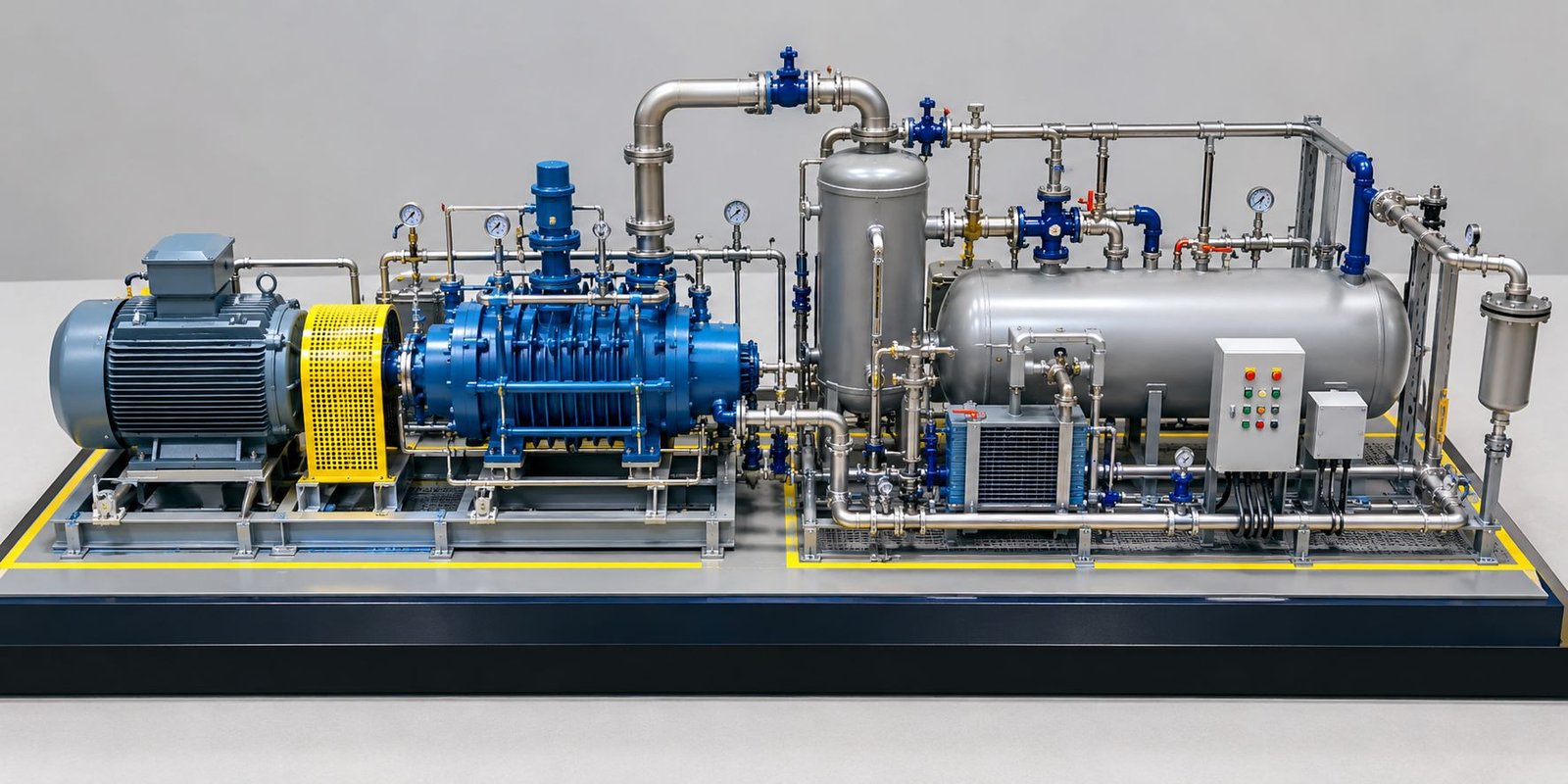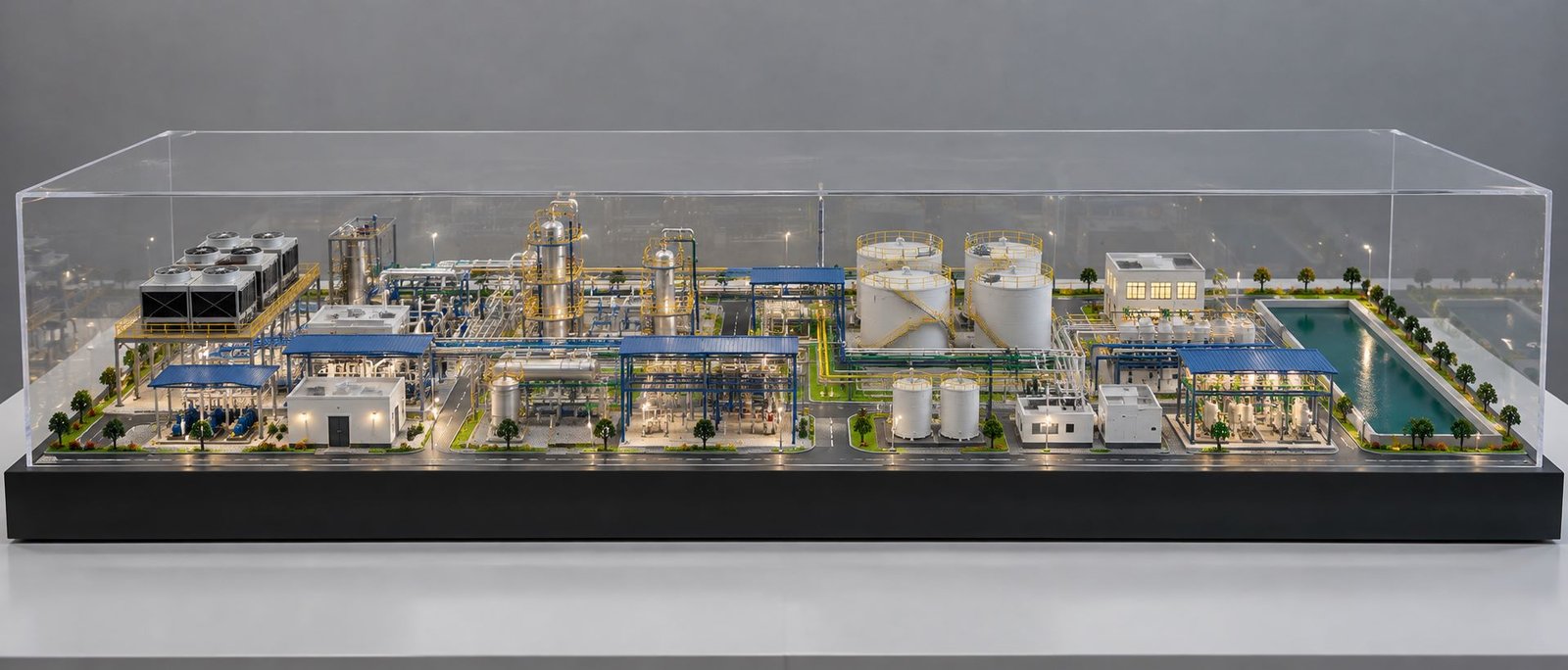
Wind Power Plant Model: Detailed Guide to Physical and Working Wind Farm Models
A Wind Power Plant Model is a detailed physical representation of a wind energy project. It shows how wind turbines, roads, electrical infrastructure, substations, control buildings, transmission lines, maintenance facilities, and surrounding land work together as one renewable energy facility. Unlike a simple miniature model with only a few turbines, a professionally made wind power plant model can represent the complete project site with realistic terrain, infrastructure, landscaping, electrical equipment, access roads, and supporting facilities.
A physical wind farm model can support architectural presentations, engineering discussions, project planning, exhibitions, educational demonstrations, investor presentations, and project visualization. In addition, it converts technical drawings and engineering concepts into a three-dimensional physical format. As a result, viewers can understand the project more easily.
The model can also become a working wind power plant model. In this version, selected turbines can rotate, LED lights can demonstrate electrical flow, and different sections can show basic operating functions. Therefore, a working model can explain both the appearance of the wind farm and the basic relationship between wind turbines and electricity generation.
What Is a Wind Power Plant Model?
A wind power plant model is a physical scale model that represents a wind energy generation facility. It can include multiple wind turbines across a large site, along with internal roads, electrical substations, transmission towers, control rooms, maintenance buildings, landscaping, drainage areas, fencing, and other supporting infrastructure.
The actual arrangement of a wind farm depends on the project site, terrain, wind conditions, turbine specifications, electrical planning, and access requirements. Therefore, the model should follow the available site plan and engineering drawings.
The main purpose of the model is to provide a clear three-dimensional representation of the entire wind power project.
For example, instead of viewing a two-dimensional site drawing, viewers can see the position of each turbine, connecting roads, substation, transmission network, maintenance facilities, and surrounding landscape in one physical model.
Moreover, a physical model can make complex engineering information easier to understand. It can show the complete relationship between different parts of the project without requiring viewers to study several separate drawings.
Why Is a Physical Wind Power Plant Model Important?
Wind power projects can cover large areas. Because of this, understanding the complete project from two-dimensional drawings can sometimes become difficult.
A physical model provides a clear three-dimensional view of the site. As a result, viewers can understand the location and relationship of major project components more quickly.
For example, the physical model can demonstrate:
- Wind turbine locations
- Turbine spacing
- Internal roads
- Electrical substation
- Transmission lines
- Power towers
- Control buildings
- Maintenance facilities
- Parking areas
- Water bodies
- Landscape
- Site boundaries
- Access gates
- Service routes
Furthermore, a physical wind power plant model can support presentations for clients, project managers, consultants, students, investors, and other stakeholders.
It can also be used during project presentations, exhibitions, engineering demonstrations, educational programs, planning discussions, and corporate displays.
Therefore, the model works as both a visual presentation tool and an engineering communication tool.
Main Components of a Wind Power Plant Model
A detailed wind power plant model should not focus only on turbines. Instead, it should represent the complete infrastructure of the wind farm.
The following components can be included according to the actual project design.
Wind Turbines in a Wind Power Plant Model
Wind turbines are the most recognizable elements of the model. Therefore, they require accurate proportions and clean fabrication.
A typical physical model can include several miniature wind turbines positioned across the site. Each turbine can contain:
- Tower
- Nacelle
- Rotor hub
- Three blades
- Base foundation
- Access area
- Surrounding service road
The turbine towers should remain proportional to the selected model scale.
Similarly, the blades should maintain accurate proportions. If the blades appear too large or too small compared with the tower, the model may lose its realistic appearance.
For a detailed presentation model, manufacturers can create turbine blades using lightweight materials. Additionally, 3D printing can produce the nacelle, rotor hub, and other small components with greater precision.
Wind Turbine Foundations
Each turbine requires a foundation area. Therefore, the physical model should also show a suitable foundation around each tower.
The foundation can appear as a circular or specially shaped platform around the turbine tower.
Furthermore, the foundation can connect directly with the internal service road. This arrangement helps viewers understand the relationship between the turbine and its maintenance infrastructure.
Small details around the foundation can include:
- Access paths
- Maintenance equipment
- Safety barriers
- Service vehicles
- Small technical components
These details can make individual turbine locations look more realistic.
Turbine Access Roads
Internal roads form an important part of a wind power plant.
Maintenance vehicles need access to individual turbines. Therefore, the model should show roads connecting the main entrance, turbine locations, substation, and maintenance buildings.
The roads can use:
- Painted road surfaces
- Fine road markings
- Gravel textures
- Curved access paths
- Turning areas
- Service routes
Moreover, the roads can follow the natural terrain of the model.
This approach becomes especially useful for large wind farms where turbines spread across hills, open fields, or uneven landscapes.
Wind Farm Terrain and Landscape for a Wind Power Plant Model
The surrounding landscape can significantly improve the appearance of a wind power plant model.
Instead of using a completely flat base, the physical model can represent gentle hills, slopes, rocky areas, valleys, agricultural land, grasslands, or other site characteristics according to the project design.
The terrain can include:
- Green fields
- Grass areas
- Small hills
- Slopes
- Rocks
- Trees
- Shrubs
- Water bodies
- Drainage channels
- Dirt paths
As a result, the model can look like a complete wind farm rather than a simple collection of miniature turbines.
Green Landscaping in a Wind Farm Model
Miniature trees, shrubs, grass textures, and small plants can add realistic details to selected areas.
However, the landscaping should remain proportional to the turbine scale.
For example, very large trees can hide the turbines. Therefore, vegetation should remain carefully distributed throughout the site.
At the same time, open areas should remain around the turbines so viewers can clearly see the main infrastructure.
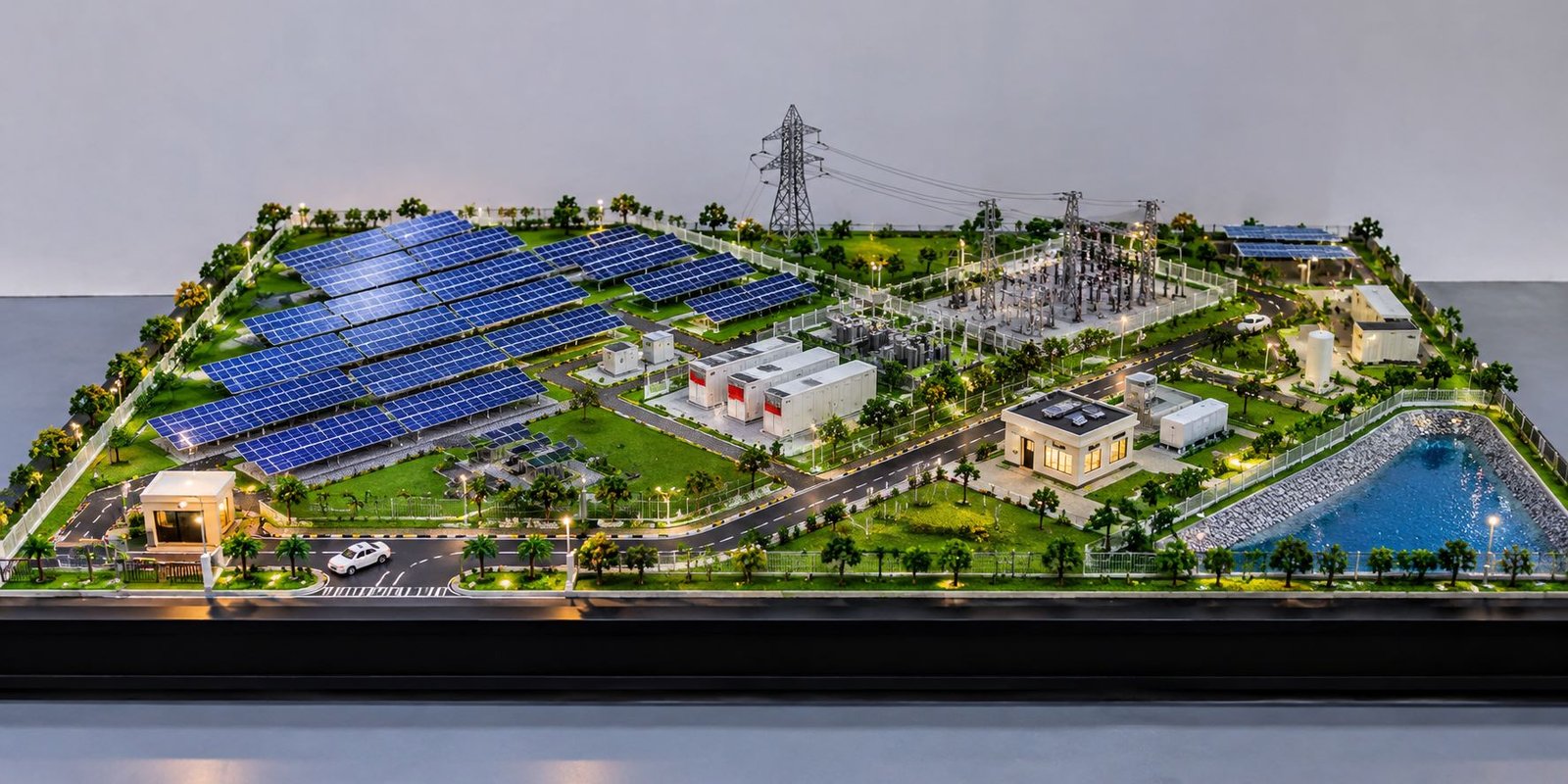
Electrical Substation in a Wind Power Plant Model
The electrical substation is one of the most important technical components of a wind power plant.
Wind turbines generate electricity, and the project then transfers that electricity through its electrical infrastructure. Therefore, a physical model can represent the substation as a dedicated fenced area.
The substation can include:
- Transformers
- Switchgear
- Busbars
- Electrical structures
- Insulators
- Control equipment
- Cable connections
- Fencing
- Maintenance paths
Manufacturers can create these components using miniature fabricated parts or 3D-printed elements.
Moreover, the substation can become one of the most detailed areas of the engineering model because it contains several small technical components.
Transmission Towers and Power Lines
Transmission infrastructure connects the substation with the external electrical network. Therefore, transmission towers can add an important engineering element to the model.
Miniature lattice towers can be positioned along the site.
The model can include:
- Transmission towers
- Electrical conductors
- Cross arms
- Insulators
- Connecting lines
- Electrical corridor
Thin wires can represent transmission conductors.
However, the wires should remain straight and proportional to the selected scale. Proper alignment can significantly improve the final appearance.
Furthermore, the transmission network adds vertical detail to the model and makes the electrical connection between the wind farm and the grid easier to understand.
Control Building
A wind power plant generally requires control and monitoring facilities. Therefore, the physical model can include a small control building near the substation.
The building may represent:
- Control room
- Monitoring area
- Electrical room
- Office space
- Equipment room
- Security area
Additionally, the model can include windows, doors, roof equipment, lighting, and small signage.
These details can make the control building look more realistic without making the overall model visually crowded.
Operation and Maintenance Building
A wind farm may also include an operation and maintenance facility.
This area can contain:
- Maintenance workshop
- Storage building
- Staff office
- Equipment storage
- Vehicle parking
- Service yard
Miniature service vehicles can be placed outside the maintenance building.
Furthermore, a small access road can connect the building with the main internal road network.
This connection helps demonstrate how maintenance teams can reach different areas of the wind farm.
Working Wind Power Plant Model
A wind power plant model can become a working model by adding rotating turbine blades.
Small electric motors can operate inside or below the turbine structures. When users activate the system, the motors rotate the turbine blades.
As a result, the model creates a dynamic presentation.
A working turbine model can demonstrate:
Wind Movement → Turbine Rotation → Mechanical Movement → Electricity Generation Concept
The model does not necessarily need to generate usable electricity. Instead, the rotating blades can demonstrate the basic operating principle.
For a more advanced engineering demonstration, miniature generators and LED indicators can also connect with selected turbines.
Working Wind Turbine Model
A working wind turbine model can focus on the movement of individual turbine blades.
The rotor assembly should remain properly balanced so that the motor can rotate it smoothly. The turbine tower should also remain firmly fixed to the model base.
A working turbine can become an important demonstration element during exhibitions, engineering presentations, educational projects, and renewable energy displays.
Furthermore, multiple turbines can operate together to create a complete working wind farm presentation.
Working LED System in a Wind Power Plant Model
LED lighting can make the model more interactive. For example, small LEDs can represent different operating sections.
These can include:
- Turbine operation
- Substation activity
- Control building
- Road lighting
- Security lighting
- Electrical transmission
- Maintenance areas
Additionally, different sections can operate through separate switches.
A control panel can remain inside the baseboard. This arrangement keeps the electrical wiring hidden and maintains a clean external appearance.
The switches can carry simple labels such as:
- Turbine ON
- Substation ON
- Transmission ON
- Road Lighting ON
- Control Building ON
Therefore, visitors can understand the model’s working functions more easily.
Electrical Flow Demonstration in a Wind Farm Model
A more advanced working model can demonstrate the basic movement of electricity.
LEDs can run from the turbine section toward the substation and then toward the transmission towers.
When the turbine system starts, the LED sequence can indicate the movement of generated power.
This provides a simple visual explanation of the electrical flow.
Furthermore, the electrical system can remain hidden below the baseboard. Only the necessary switches, indicators, and lighting points need to remain visible.
Wind Farm Road Network and Site Planning
Road planning is another important part of the model.
The internal road network should connect:
- Main entrance
- Turbine locations
- Substation
- Maintenance building
- Control building
- Storage areas
- Service yard
The road width should remain proportional to the selected scale.
Moreover, the road surface can use dark materials, fine painted markings, and small roadside elements.
Miniature vehicles can also appear at selected locations.
These vehicles help viewers understand the scale of the wind farm and demonstrate the movement required for maintenance and operations.
Main Entrance and Security Gate
A detailed wind power plant model can include a dedicated entrance gate.
The entrance may contain:
- Security cabin
- Sliding gate
- Barrier
- Boundary fencing
- Entry road
- Exit route
- Visitor parking
Small security lights can also appear around the entrance.
In addition, a miniature service vehicle near the gate can improve the realistic appearance of the site.
Fencing and Site Boundary
Large renewable energy projects generally require clearly defined site boundaries.
Therefore, the physical model can represent the boundary with miniature fencing.
Fencing can surround:
- Main plant area
- Substation
- Control building
- Maintenance facility
- Storage yard
The fencing should remain delicate and proportional to the selected scale.
Laser-cut or fine-wire elements can provide clean and realistic results.
Water Bodies and Drainage
If the project site contains natural water bodies, ponds, drainage channels, or small reservoirs, the model can include these features as well.
Blue transparent acrylic, resin, or other suitable materials can represent water.
Moreover, small bridges, drainage paths, rocks, vegetation, and embankments can surround the water areas.
As a result, the terrain can appear more natural and visually detailed.
Industrial Support Buildings
A large wind power project may require additional supporting facilities.
Depending on the project design, the model can include:
- Storage sheds
- Equipment buildings
- Workshops
- Warehouses
- Utility rooms
- Parking structures
- Temporary project facilities
These structures can use simple architectural forms with suitable facade details.
Consequently, the supporting buildings can remain visible without taking attention away from the turbines.
Materials Used for Wind Power Plant Models
The material selection depends on the model scale and required level of detail.
Acrylic
Acrylic can be used for:
- Transparent structures
- Water bodies
- Windows
- Control panels
- Lighting elements
MDF
MDF can be used for:
- Baseboard
- Terrain layers
- Buildings
- Platforms
- Structural components
Foam Board
Foam board works well for lightweight terrain and building massing.
PVC Sheets
PVC sheets can create clean architectural components and small structures.
3D Printing for Wind Power Plant Models
3D printing is particularly useful for:
- Turbine components
- Nacelles
- Electrical equipment
- Vehicles
- Buildings
- Utility structures
- Technical components
Laser Cutting for Wind Farm Models
Laser cutting can produce accurate:
- Fences
- Panels
- Building components
- Road elements
- Structural details
- Signage
- Electrical components
As a result, combining several fabrication methods can provide better accuracy and detailing.
Baseboard Design for a Wind Power Plant Model
The baseboard plays an important role in the overall presentation.
For a large wind power plant model, a wide rectangular baseboard can provide a strong presentation format.
The model can use a rectangular footprint with a clean border around the site.
The baseboard can include:
- Wind turbines
- Roads
- Substation
- Control building
- Maintenance building
- Landscape
- Transmission towers
- Water bodies
- Entrance gate
- Service areas
A wider baseboard works particularly well when the model will appear as a website feature image.
Furthermore, the turbine arrangement can remain visually low and wide across the baseboard. This allows the photograph to show more of the complete site.
Low-Height and Wide Wind Power Plant Model Composition
For photography and website presentation, the overall composition matters.
Wind farms contain tall turbine towers. However, the surrounding site can use a wide horizontal composition so the final photograph captures the complete project.
The camera can sit slightly above the front edge of the baseboard.
This position can show:
- Turbine blades
- Turbine towers
- Roads
- Substation
- Transmission towers
- Buildings
- Landscape
- Water bodies
- Site boundary
At the same time, the rectangular baseboard remains clearly visible.
Therefore, this type of composition works well as a blog feature image because viewers can understand the complete wind power plant from a single photograph.
Lighting Design for a Wind Power Plant Model
Lighting can enhance the visual presentation of a physical wind power plant model.
Warm or neutral LEDs can illuminate:
- Control buildings
- Maintenance buildings
- Substation
- Roads
- Entrance gate
- Landscape
- Security areas
Small lights can also appear along internal roads.
Furthermore, the lighting wires should remain hidden inside the baseboard whenever possible.
For a working model, separate switches can control different lighting zones.
Electrical Substation Detailing
The substation deserves special attention because it gives the model a strong engineering character.
Small transformers, busbars, switchgear, insulators, structures, cables, and fencing can appear inside the substation area.
The substation can sit toward the front or central portion of the model so viewers can clearly see the electrical infrastructure.
Moreover, small warning signs and access gates can add additional technical detail.
Maintenance Vehicles and Equipment
Miniature vehicles can demonstrate how the wind farm operates.
The model can include:
- Maintenance trucks
- Service vans
- Crane vehicles
- Utility vehicles
- Transport trucks
A crane can appear near one of the turbines to represent maintenance activity.
Similarly, equipment storage areas can contain miniature components.
These elements make the model look more like an active power generation site.
Wind Turbine Blade Detailing
The turbine blades are among the most visible components.
Therefore, each blade should have a smooth and accurate shape.
For a realistic physical model, the blades can have:
- Proper aerodynamic form
- Smooth edges
- Accurate length
- Central hub
- Balanced arrangement
- Appropriate surface finish
The three blades should align correctly around the central hub.
For a working model, the rotating assembly should remain balanced so the motor can operate smoothly.
Working Automatic Features in a Wind Power Plant Model
Advanced wind power plant models can include additional interactive features.
Possible features include:
- Rotating turbine blades
- Automatic entrance gate
- LED turbine indicators
- Substation lighting
- Road lighting
- Transmission indicators
- Emergency lighting
- Control panel
- Demonstration switches
Therefore, these features can transform a conventional static model into an interactive engineering demonstration.
Model Scale and Proportion
Scale selection is important because wind turbines are tall structures.
If the turbine height becomes too large at a particular scale, the complete wind farm may become too tall for the presentation base.
Therefore, a smaller scale can help create a wide site composition.
At the same time, important details such as turbine blades, roads, substation equipment, buildings, vehicles, and transmission towers should remain visible.
The selected scale should balance:
Overall Site Size + Turbine Height + Engineering Detail + Physical Manufacturing + Presentation Quality
This balance helps create a realistic and practical model.
Wind Power Plant Model Presentation and Photography
The final model should be photographed carefully.
A slightly elevated three-quarter view can provide a clear view of the complete wind farm.
The image should show the rectangular baseboard, turbines, roads, electrical infrastructure, buildings, landscape, and supporting facilities.
Furthermore, a neutral background can keep attention on the model.
The physical model should also have clean edges, precise finishing, realistic materials, and balanced landscaping.
For a website blog, the feature image should preferably show the complete model rather than focusing on a single turbine.
Applications of a Wind Power Plant Model
A physical wind power plant model can support many applications.
It can be used for:
- Engineering presentations
- Renewable energy exhibitions
- Educational demonstrations
- Project planning
- Client presentations
- Investor presentations
- Project visualization
- Architectural presentations
- Infrastructure exhibitions
- Corporate displays
- Academic projects
- Training demonstrations
Moreover, a working model can be especially useful when the objective is to explain the basic operation of wind energy generation.
Conclusion
A Wind Power Plant Model is a detailed physical representation of a renewable energy facility. It can combine wind turbines, turbine foundations, access roads, electrical substations, transmission towers, control buildings, maintenance facilities, landscaping, water bodies, fencing, vehicles, and other infrastructure into one complete physical presentation.
A professionally developed model should focus not only on the turbines but also on complete site planning and engineering infrastructure. In this way, viewers can understand how the different parts of the wind power project connect with each other.
A working wind power plant model can provide an additional level of interaction. Rotating turbine blades, LED indicators, illuminated substations, working gates, and control switches can demonstrate different parts of the project.
Furthermore, a wide rectangular baseboard can provide a strong presentation format for large wind farm models. A low and wide composition allows the complete site to remain visible while providing enough space for detailed turbines, roads, electrical systems, landscape, buildings, and supporting infrastructure.
The quality of the final model depends on accurate project drawings, suitable scale selection, precise fabrication, realistic materials, detailed turbine components, clean landscaping, proper electrical installation, and professional finishing.
From a simple static wind turbine display to a highly detailed working wind farm with rotating turbines and illuminated electrical infrastructure, the model can be customized according to project requirements.
Ultimately, a well-made wind power plant model transforms a complex renewable energy project into a clear, realistic, and tangible three-dimensional presentation. It allows viewers to understand the overall site, visualize the relationship between turbines and electrical infrastructure, and appreciate the planning behind a modern wind energy facility.