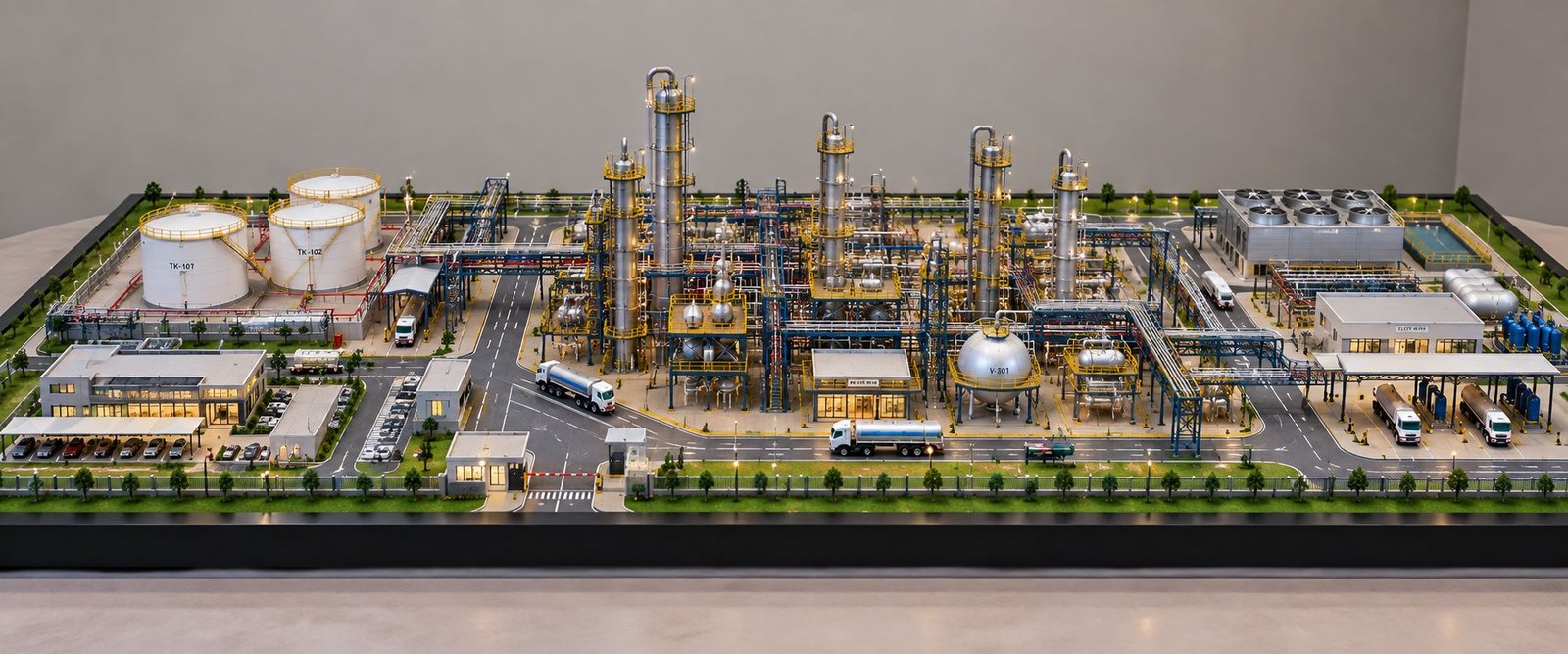
Wastewater Treatment Plant Engineering Model: Advanced Physical Engineering Model
An Engineering Model is a tool for effective understanding, demonstrating and sharing of engineering ideas in a simple and understandable format.
The presented model is an advanced Wastewater Treatment Plant Engineering Model representing various processes involved in wastewater treatment. The physical model represents treatment tanks, aeration zones, pumping systems, filtration sections, pipelines, water-flow management and other important aspects of a modern wastewater treatment plant.
The model is particularly useful for Civil Engineering, Environmental Engineering, Water Treatment Engineering, Wastewater Management, academic projects, technical exhibitions and engineering presentations.
What Is a Wastewater Treatment Plant?
Wastewater Treatment Plant is an engineered facility designed to treat wastewater and reduce unwanted solids, organic matter, pollutants and other contaminants prior to discharge or suitable reuse.
Wastewater treatment generally involves a series of processes instead of a singular process. Depending on the desired outcome, wastewater may include preliminary treatment, primary treatment, secondary biological treatment, filtration, disinfection, advanced treatment and other components. The engineering model represents this concept in a compact plant layout where different treatment zones are interconnected to illustrate the overall process.
What Does This Engineering Model Represent?
The model represents an integrated wastewater treatment facility where wastewater is guided through different treatment and processing areas. The model incorporates major engineering zones such as:
Treatment and settling tanks
Aeration basins
Water-flow channels
Pumping systems
Filtration units
Pressure-treatment equipment
Interconnected pipelines
Flow-control sections
Supporting infrastructure
The model emphasizes not just the representation of individual equipment, but the demonstration of how different engineering processes operate together as an integrated treatment system, making it a suitable Process Flow Engineering Model rather than a simple architectural display.
Understanding the Wastewater Treatment Process
Understanding the process flow is key to interpreting this engineering model. Wastewater normally undergoes multiple stages, with each stage fulfilling a certain treatment role.
1. Preliminary Treatment
Preliminary treatment is generally the first stage of wastewater treatment. Its main function is to remove large and coarse materials that could interfere with downstream equipment and treatment processes. Screening and grit removal are common preliminary treatment operations.
Screening can help remove large floating and suspended objects, while grit removal can assist in separating heavier inorganic particles such as sand and small stones.
The initial flow-arrangement and treatment sections can be used to help understand this concept in the physical engineering model.
2. Primary Treatment
After preliminary treatment, wastewater can enter the primary treatment stage. Primary treatment commonly employs sedimentation to separate settleable suspended solids from wastewater. When wastewater is retained under controlled conditions, heavier particles will settle at the bottom while the comparatively clarified water can move towards subsequent treatment stages. The treatment tanks represented in the engineering model can help demonstrate how controlled water retention and separation can facilitate an important part of the overall treatment process.
3. Secondary Biological Treatment
One of the most important stages of a wastewater treatment plant is secondary biological treatment. Biological treatment utilizes microorganisms to break down biodegradable organic matter present in wastewater. One widely used approach is the activated sludge process.
In an activated sludge system, wastewater is brought into contact with microorganisms under controlled conditions. Aeration supplies oxygen, supporting biological activity and allowing microorganisms to consume and transform biodegradable organic pollutants. The engineering model prominently represents the aeration and biological treatment zones, aiding in the visualisation of this important engineering principle.
Importance of the Aeration System
Aeration is a crucial function in many biological wastewater treatment systems.
The purpose of aeration is to transfer oxygen into wastewater and maintain conditions suitable for aerobic microorganisms. With appropriate oxygen availability, biological processes responsible for reducing biodegradable organic matter can take place. The aeration basin represented in the physical model makes it possible to understand the interrelation between water flow, oxygen transfer, biological activity and treatment performance.
This is one of the reasons the model is useful for explaining environmental and process engineering concepts.
Pumping and Fluid-Flow Engineering
The movement of fluids is one of the basic engineering requirements for a wastewater treatment facility. Water must move between treatment units in a controlled manner. Pumps, pipelines, valves, channels, and other flow-control systems can be used. The interconnected pipeline network and pumping units shown in the engineering model demonstrate the hydraulic connectivity between different treatment zones.
Filtration and Advanced Treatment
After biological treatment, additional treatment may be required to meet specific requirements for the treated water. Advanced or tertiary treatment may include processes such as filtration, disinfection, nutrient removal and other specialized treatment technologies. The filtration and pressure-treatment section represented in the model demonstrates the concept of additional treatment after the primary and biological stages.
Engineering Role of Treatment Tanks
Treatment tanks are fundamental components of wastewater treatment infrastructure. Different tanks can fulfill different functions, depending on the treatment process and plant configuration. These may include:
Flow equalization
Aeration
Biological treatment
Sedimentation
Clarification
Solids separation
Water polishing
The physical model unifies these different process concepts in one compact layout.
Sludge Management in Wastewater Treatment
Wastewater treatment does not simply result in treated water. It also involves additional processes to manage sludge and residual solids. Primary and biological treatment processes can generate solids that require additional treatment and handling. For example, thickening, stabilization, digestion, dewatering and appropriate final handling may be employed. Therefore, understanding of the wastewater treatment engineering requires consideration of both the water-treatment flow and the solids-management process. The model provides an effective platform for discussion of this broader treatment-system concept.
How Does a Physical Engineering Model Improve Understanding?
The main advantage of a physical engineering model is the ability to convert an abstract technical process into a three-dimensional visual system. A conventional process diagram may use symbols, lines, arrows and labels to represent a treatment plant. This may appear challenging to beginners. A physical model provides an opportunity to observe the spatial relationship between:
The wastewater inlet
Treatment units
Aeration zones
Pumping systems
Filtration sections
Interconnecting pipelines
Water-flow paths
Final treatment stages
Major Benefits of Building an Engineering Model
1. Simplifies Complex Engineering Concepts
Wastewater treatment plants involve multiple interconnected processes. A physical model simplifies these systems through a single visual framework. Students and viewers can understand how different treatment stages work together instead of studying each process individually.
2. Improves Process-Flow Understanding
A model makes it easier to follow the movement of wastewater from one treatment stage to another. It illustrates how the output from one process can become the input for the next process, forming a continuous treatment sequence.
3. Supports Engineering Education
A Wastewater Treatment Plant Model can be particularly useful in:
Civil Engineering
Environmental Engineering
Water Resources Engineering
Environmental Technology
Diploma Engineering
Polytechnic education
It provides a useful visual reference alongside theoretical concepts.
4. Enhances Engineering Project Presentations
A physical model can significantly improve the presentation of an engineering project. Instead of relying solely on drawings and diagrams, students and engineers can demonstrate the complete plant concept in a three-dimensional format.
5. Helps Explain Plant Layout
The arrangement of treatment units is an important element of plant planning. A model helps to explain the relative positioning of treatment tanks, pumping systems, filtration units, pipelines and other process areas.
6. Supports Design Discussions
An engineering model can be used during preliminary design discussions to visually examine the interrelation between different plant components. The relative positioning of treatment units, pipeline connectivity, process sequence and pumping arrangements can be discussed more easily when they are presented physically.
7. Makes Technical Information Accessible
Wastewater treatment is a highly technical subject. A physical model can make the subject accessible to audiences without an advanced engineering background. This is particularly useful for engineering exhibitions, educational demonstrations, institutional presentations and public-awareness programs.
Applications of the Wastewater Treatment Plant Engineering Model
This type of engineering model can be used in a wide range of academic and professional environments.
Civil Engineering Projects
Civil engineering students can use the model to understand wastewater infrastructure, treatment-unit arrangements, plant planning and system integration.
Environmental Engineering Projects
Environmental engineering students can use the model to demonstrate wastewater treatment, pollution control, biological treatment, water-quality management and environmental protection concepts.
Diploma and Polytechnic Projects
For diploma and polytechnic-level projects, a physical model can offer a practical way to demonstrate engineering principles and process flow.
Engineering Exhibitions
An engineering exhibition model can draw attention while providing clear explanation of how a wastewater treatment facility works.
Final-Year Engineering Projects
A detailed physical model can enhance a final-year project presentation by providing a visual representation of the proposed treatment system and its process sequence.
Engineering Model vs. Real Wastewater Treatment Plant
It is important to note that a physical engineering model is a scaled representation of an engineering concept and not a substitute to a functioning commercial wastewater treatment plant.
A real treatment plant requires detailed engineering calculations and design considerations that involve parameters such as:
Design flow rate
Hydraulic loading
Retention time
Organic loading
Biological loading
Equipment capacity
Treatment efficiency
Sludge generation
Hydraulic profile
Water-quality requirements
Applicable regulations
The physical model serves the purposes of education, visualization, communication, demonstration and engineering presentation.
Advanced Wastewater Treatment Concept
Modern wastewater treatment facilities can incorporate progressively advanced treatment technologies when higher water-quality objectives are required. Depending on the application, advanced wastewater treatment may involve nutrient removal, enhanced filtration, disinfection, membrane-based processes and other specialized technologies. The model’s integrated arrangement assists in demonstrating the concept that wastewater treatment is a multi-stage engineering process where mechanical, hydraulic, biological and environmental engineering principles operate together.
Engineering Significance of This Model
The engineering significance of this model lies in the integration of multiple treatment functions.
The model incorporates:
Wastewater flow
Treatment tanks
Aeration
Biological treatment
Pumping
Filtration
Pressure-based treatment
Pipeline networks
Process integration
Water-flow management
Instead of viewing these as independent elements, the model demonstrates how they can operate as part of a wastewater treatment system.
For this reason, it can be referred to as an Integrated Wastewater Treatment Plant Engineering Model.
Conclusion
The Wastewater Treatment Plant Engineering Model is an advanced physical engineering representation designed to demonstrate the major processes involved in wastewater treatment. By presenting treatment tanks, aeration zones, pumping systems, filtration sections, pipelines and interconnected process areas within a single physical layout, the model makes complex wastewater-treatment concepts easy to understand. Its applications extend across Civil Engineering, Environmental Engineering, Water Treatment Engineering, Diploma Engineering, Polytechnic Projects, Final-Year Projects, Engineering Exhibitions, Academic Demonstrations and Technical Presentations. The greatest benefit of a physical engineering model is its ability to transform complex technical information into a clear three-dimensional representation, enabling viewers to understand not only individual treatment processes but also the interrelation, sequence, connectivity and integration between different engineering systems.