Pharmaceutical Formulation Plant Model Making: Detailed Industrial Scale Models for Pharma Manufacturing Facilities
Introduction
The pharmaceutical industry plays an important role in modern healthcare. Pharmaceutical companies manufacture tablets, capsules, syrups, injections, creams, and many other medicines. Behind these products, a complete manufacturing facility manages raw materials, production equipment, quality testing, packaging, and storage. Therefore, a well-planned pharmaceutical factory needs a clear layout and a suitable arrangement of every department.
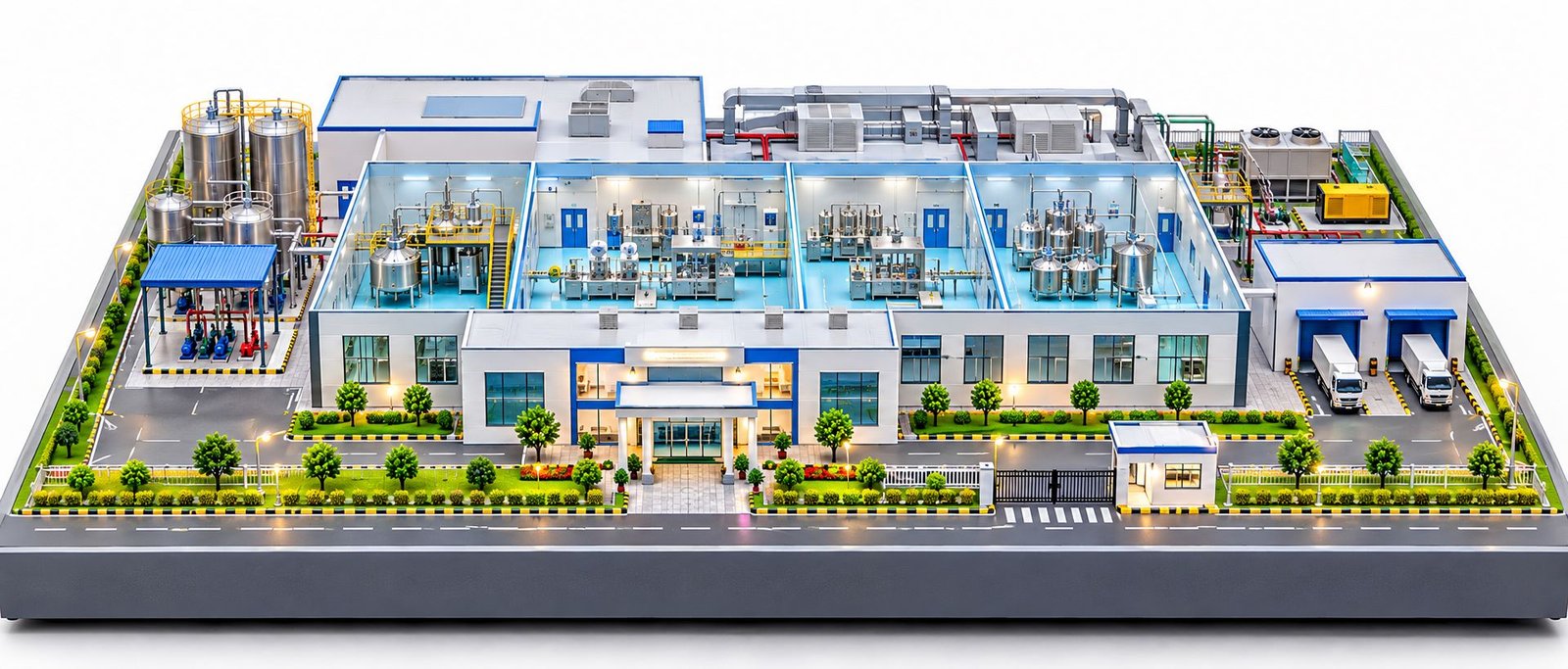
A Pharmaceutical Formulation Plant Model provides a detailed physical view of this industrial setup. It brings the complete manufacturing facility into one three-dimensional presentation. For example, a model can show raw material storage, dispensing rooms, mixing vessels, granulation machines, tablet compression units, capsule filling equipment, and packaging lines.
Moreover, a physical scale model helps pharmaceutical companies explain their factory layout during business meetings, project presentations, exhibitions, and technical discussions. Instead of showing several separate drawings, project teams can present the entire facility on one rectangular baseboard.
PAL Design Models develops customized architectural, industrial, and engineering scale models for different industries. The company focuses on physical models that combine building structures, miniature machinery, pipelines, equipment, and other important details.
In addition, pharmaceutical plant models can represent small formulation units as well as large manufacturing complexes. Their design depends on the available drawings, factory dimensions, equipment details, and presentation goals.
Furthermore, a detailed pharmaceutical scale model helps clients understand the complete manufacturing facility without studying multiple technical drawings. It also provides a clear view of the relationship between different production departments.
This article explains pharmaceutical formulation plant model making, important manufacturing sections, industrial equipment, design features, fabrication methods, and the benefits of a professional physical scale model.
What Is a Pharmaceutical Formulation Plant Model?
A Pharmaceutical Formulation Plant Model is a miniature physical representation of a factory that manufactures finished pharmaceutical products. The model explains how a manufacturing facility organizes its production rooms, machinery, laboratories, warehouses, and utility systems.
For example, a tablet manufacturing facility may contain separate areas for material storage, weighing, blending, granulation, drying, compression, coating, and packaging. A detailed model can display these departments within one connected industrial layout.
Similarly, a liquid medicine manufacturing plant may include preparation tanks, mixing vessels, filtration equipment, filling machines, and bottle packaging lines.
The model can also show the factory’s external appearance. This includes production buildings, administrative blocks, loading areas, parking spaces, internal roads, security gates, and utility sections.
Furthermore, transparent walls and open-roof structures can reveal the machinery inside each production department. As a result, viewers can understand both the architectural layout and the manufacturing arrangement.
A pharmaceutical industrial scale model can follow the actual project drawings. However, the model maker can also create a conceptual layout when the client needs an early-stage project presentation.
In addition, the model can represent different pharmaceutical production facilities according to their manufacturing requirements. These may include tablet plants, capsule production units, liquid medicine factories, and integrated pharmaceutical manufacturing complexes.
Importance of Pharmaceutical Manufacturing Plant Scale Models
Pharmaceutical manufacturing involves several departments and different types of industrial equipment. Each department performs a specific task, so the complete facility needs a clear and organized layout.
A pharmaceutical plant scale model makes this complex arrangement easier to understand. It presents the factory from a three-dimensional viewpoint and connects the different departments visually.
Moreover, the model helps project teams explain the relationship between production areas, storage facilities, laboratories, and utility buildings.
Better Industrial Project Presentations
A physical model gives clients a clear view of the proposed manufacturing facility. They can examine the building arrangement, equipment locations, internal roads, and supporting infrastructure.
Therefore, pharmaceutical companies can use these models during project meetings, investor presentations, and corporate exhibitions.
Furthermore, a detailed model can help management teams understand the complete project without examining multiple technical drawings.
Clear Equipment Visualization
Technical drawings often require viewers to understand several symbols and dimensions. In contrast, a physical model shows miniature equipment in its actual position.
For example, viewers can identify storage tanks, mixers, processing machines, pumps, pipelines, and packaging systems without studying multiple drawings.
Additionally, open-roof buildings and transparent partitions allow viewers to examine internal machinery more easily.
Better Understanding of Factory Layout
A pharmaceutical factory contains different production and support departments. A scale model brings these sections together in one presentation.
Moreover, transparent partitions and open building sections help viewers examine the internal arrangement.
For this reason, project teams can use physical models to explain the relationship between manufacturing rooms, warehouses, laboratories, and utility areas.
Useful for Exhibitions and Corporate Displays
Pharmaceutical companies can display industrial models at trade shows, business events, and company offices.
Furthermore, a professionally finished model can highlight the company’s manufacturing capacity and industrial infrastructure.
As a result, the model becomes a useful presentation element for corporate meetings and industrial exhibitions.
Major Sections of a Pharmaceutical Formulation Plant
A pharmaceutical formulation facility contains different departments according to its products and manufacturing processes. The exact layout depends on production capacity, dosage forms, equipment requirements, and factory planning.
A detailed Pharmaceutical Formulation Plant Model can include the following sections.
Raw Material Receiving and Storage Area
The raw material department handles incoming ingredients and manufacturing supplies. It provides the starting point for the production process.
A physical model can show a receiving building, unloading platform, storage rooms, material racks, and handling equipment.
For example, separate storage areas can represent active pharmaceutical ingredients, excipients, and packaging materials.
Moreover, miniature pallets, drums, containers, and storage racks can improve the industrial appearance.
In addition, separate storage zones help explain how the factory organizes different materials before production.
Dispensing and Weighing Department
The dispensing department prepares the required quantities of ingredients for each production batch.
This section can include weighing stations, dispensing booths, material containers, and stainless steel worktables.
Furthermore, the model can show separate rooms for material preparation and controlled handling.
These details help viewers understand the movement of ingredients from storage towards manufacturing.
Additionally, separate dispensing rooms help explain how the facility manages different materials during production.
Pharmaceutical Mixing and Blending Area
Mixing and blending play an important role in pharmaceutical formulation. These operations help combine different ingredients according to the product requirements.
A detailed industrial model can include stainless steel mixing tanks, industrial blenders, agitators, and material transfer systems.
For solid dosage production, the layout may feature bin blenders and double-cone blenders. Similarly, liquid formulation areas may contain large mixing vessels and preparation tanks.
Furthermore, visible pipelines and equipment connections can improve the overall presentation.
For instance, the model can show how different vessels connect with pumps and transfer lines.
Granulation and Processing Section
Granulation helps prepare powder materials for further processing, especially in tablet manufacturing.
This department may contain high-shear mixers, fluid bed processors, granulation machines, and related equipment.
A physical model can show these machines inside a separate production hall.
Additionally, miniature platforms, access ladders, control panels, and material handling equipment can add realistic details.
As a result, viewers can easily identify the equipment used during different manufacturing operations.
Drying and Milling Department
Drying and milling help prepare processed materials for the next manufacturing stage.
A pharmaceutical plant model can include fluid bed dryers, tray dryers, industrial mills, pulverizers, and screening machines.
Moreover, equipment placement should reflect the actual factory layout.
Small ducts, connecting pipes, machine housings, and collection containers can make this department more recognizable.
Similarly, the designer can use separate production zones to present different processing activities.
Tablet Compression Section
Tablet compression converts prepared powder or granules into tablets through specialized machines.
This section forms an important part of many pharmaceutical formulation facilities.
A detailed model can display rotary tablet compression machines, feeding hoppers, control panels, and discharge arrangements.
Furthermore, multiple miniature machines can represent a large production hall.
The designer can use open-roof structures or transparent walls to keep the machinery visible from the main viewing angle.
In addition, miniature equipment can show the relationship between tablet compression and the following production stages.
Capsule Filling Department
Capsule production requires specialized filling and handling equipment.
A pharmaceutical manufacturing model can show capsule filling machines, powder feeding systems, capsule polishing equipment, and inspection stations.
Additionally, a separate room can represent the capsule production department.
The model should show a clear connection between the production equipment and the next manufacturing or packaging section.
Similarly, the designer can include material handling equipment and inspection workstations to complete the department.
Tablet Coating Department
Tablet coating adds a protective or functional layer to tablets.
This section can feature coating pans, perforated coating machines, spray equipment, preparation tanks, and ventilation connections.
Moreover, the model can show separate equipment areas according to the factory layout.
Different flooring and room partitions can help viewers identify this department.
For example, miniature preparation vessels and connecting pipelines can add more technical detail.
Liquid Medicine Manufacturing Section
Many pharmaceutical factories produce syrups, suspensions, and other liquid medicines.
A liquid formulation department generally contains preparation tanks, mixing vessels, transfer pumps, filtration units, and holding tanks.
A physical model can connect these components through miniature pipelines.
In addition, the design may include a separate liquid filling room with bottle handling and packaging equipment.
For example, connected tanks and pipelines can explain the movement of liquid products between different processing stages.
Cream and Ointment Manufacturing Section
Cream and ointment production requires special mixing and processing equipment.
A detailed model can include vacuum emulsifying mixers, stainless steel vessels, homogenizers, transfer pumps, and storage tanks.
Furthermore, separate production rooms can represent different formulation activities.
The designer can add metallic finishes and small connecting pipes to improve the appearance of this section.
Moreover, miniature equipment can help viewers understand the layout of specialized pharmaceutical production areas.
Important Machinery and Equipment in a Pharmaceutical Plant Model
Industrial equipment gives a pharmaceutical formulation model its main identity. Therefore, the model maker should select machinery according to the actual manufacturing process.
The following equipment can add important details to the physical model.
Stainless Steel Mixing Tanks
Mixing tanks handle different preparation activities. Miniature versions can feature cylindrical bodies, top covers, outlets, support legs, and connecting pipes.
Moreover, metallic finishing can give these tanks a realistic industrial appearance.
Industrial Processing Vessels
Processing vessels represent important production equipment. Their design can include metallic surfaces, inspection openings, connecting points, and supporting structures.
Similarly, different vessel sizes can represent different manufacturing capacities.
High-Shear Mixers
These machines can occupy the granulation section and help explain the powder processing arrangement.
In addition, the model can show their position alongside other processing equipment.
Fluid Bed Dryers
Fluid bed dryers add technical detail to the manufacturing area. Their miniature structures can include processing chambers, ducts, and supporting equipment.
Furthermore, visible connections can make their arrangement easier to understand.
Tablet Compression Machines
These machines can feature compact metallic bodies, feeding hoppers, control panels, and discharge points.
As a result, the tablet production department becomes more detailed and informative.
Capsule Filling Machines
Miniature capsule filling equipment can represent the capsule manufacturing department.
Moreover, the model can show inspection and material handling areas alongside the machines.
Coating Equipment
Coating machines can include rotating pans, support frames, and connected preparation equipment.
Similarly, separate equipment arrangements can represent different coating operations.
Industrial Pumps and Motors
Pumps and motors connect different processing systems. Their miniature versions can improve the equipment arrangement.
Additionally, connecting pipes can show their relationship with storage and processing vessels.
Filtration Systems
Filter housings, filtration vessels, and pipelines can represent liquid processing activities.
Furthermore, these components can improve the technical appearance of the model.
Packaging Machines
Blister machines, bottle filling units, labeling machines, cartoning equipment, and conveyors can complete the packaging section.
Finally, a connected packaging line can present the complete product handling arrangement.
Pharmaceutical Cleanroom and Controlled Manufacturing Areas
Cleanroom planning plays an important role in pharmaceutical manufacturing. Different production activities may require controlled environmental conditions and suitable protection against contamination.
A pharmaceutical formulation plant model can represent cleanroom areas through enclosed rooms, transparent partitions, access doors, and separate entry zones.
For example, the layout may include gowning rooms, material transfer areas, equipment preparation rooms, and controlled production spaces.
Moreover, transparent acrylic walls can help viewers examine the internal arrangement.
The model can also show separate rooms for different manufacturing operations. This arrangement makes the production layout easier to understand.
In addition, the designer can use different floor finishes and room partitions to identify controlled manufacturing areas.
However, a physical scale model only represents the proposed design. It does not prove actual cleanroom performance or regulatory compliance.
HVAC System and Air Handling Infrastructure
The HVAC system supports pharmaceutical manufacturing by managing temperature, humidity, airflow, and room pressure.
Therefore, a detailed pharmaceutical industrial model should consider the HVAC infrastructure when the project requires it.
The model can include:
- Air handling units.
- HVAC duct networks.
- Air filtration equipment.
- Fresh air intake systems.
- Exhaust ventilation units.
- Rooftop ventilation equipment.
- Utility platforms.
- Air distribution connections.
For example, rooftop air handling units can connect to visible ducts above the production buildings.
Additionally, separate ventilation equipment can represent different manufacturing departments.
These components give the model a more complete industrial appearance. As a result, viewers can understand the role of supporting engineering systems.
Pharmaceutical Water Treatment and Purification Plant
Pharmaceutical manufacturing requires water for different production activities and cleaning operations. The required water quality depends on its intended use.
A pharmaceutical formulation plant model can include a separate water treatment section.
This area may feature raw water tanks, filtration units, water softeners, reverse osmosis systems, purified water storage tanks, pumps, and distribution pipelines.
Moreover, a model can show stainless steel water storage vessels and connecting pipes.
A dedicated water treatment building can also help viewers identify the supporting utility infrastructure.
Furthermore, the model can show how different water treatment components occupy a separate area within the industrial facility.
Quality Control and Quality Assurance Laboratories
Quality departments support pharmaceutical companies throughout the manufacturing process.
The quality control laboratory handles product testing and different analytical activities. Meanwhile, quality assurance manages quality systems, records, and process controls.
A pharmaceutical factory model can include separate laboratory buildings and testing rooms.
For example, the model may feature:
- Chemical testing laboratory.
- Microbiology laboratory.
- Instrument testing room.
- Stability testing area.
- Sample storage room.
- Laboratory workstations.
- Quality documentation office.
Additionally, miniature testing equipment, worktables, cabinets, and internal partitions can make these areas more realistic.
Similarly, separate laboratory sections can highlight the importance of product testing and quality management.
Pharmaceutical Packaging and Labelling Section
Packaging prepares finished medicines for storage, identification, and distribution.
This department can feature several miniature machines arranged in a connected production line.
For example, a tablet packaging section may include blister packaging machines, strip packing equipment, and cartoning units.
Similarly, liquid medicine packaging may include bottle washing, filling, capping, and labeling machines.
A detailed model can also feature conveyor belts, inspection equipment, and product handling stations.
Furthermore, connected packaging equipment helps explain how products move through the final manufacturing stage.
Consequently, the packaging section becomes an important part of the overall pharmaceutical plant presentation.
Finished Goods Warehouse and Dispatch Area
The finished goods warehouse stores packed products before distribution.
A pharmaceutical plant model can represent this department through a large warehouse building, storage racks, loading platforms, and dispatch areas.
Miniature pallets, cartons, delivery vehicles, and loading arrangements can add useful details.
Moreover, internal roads can connect the warehouse with the main factory entrance.
This arrangement helps viewers understand the movement of finished products from the manufacturing area towards dispatch.
In the same way, loading platforms and storage racks make the dispatch arrangement easier to understand.
Utility and Engineering Infrastructure
A pharmaceutical factory needs supporting utility systems to maintain daily operations.
Therefore, a detailed industrial scale model can include a separate utility area.
Important installations may include:
- Boiler house.
- Air compressor systems.
- Chiller plant.
- Cooling towers.
- Electrical substation.
- Diesel generator room.
- Transformer installation.
- Fire protection system.
- Water storage tanks.
- Utility pipelines.
- Electrical control panels.
Additionally, the model can show connections between the utility area and production buildings.
Visible pipes, ducts, and equipment platforms can improve the overall industrial detailing.
Apart from production machinery, utility installations also contribute to the overall appearance of the industrial model.
Architectural Planning and Layout of a Pharmaceutical Plant Model
The architectural layout plays an important role in the overall appearance of a pharmaceutical manufacturing model.
A well-planned facility may contain several production buildings, warehouses, laboratories, and utility structures.
The main manufacturing block can occupy the central area of the site. Meanwhile, the warehouse and loading facilities can sit near the dispatch entrance.
Similarly, the utility building can occupy a separate service zone.
The model can also include internal roads, pedestrian paths, parking spaces, security gates, boundary walls, and landscaped areas.
For a feature image, a wide rectangular layout with relatively low building heights can provide a better view of the complete facility.
However, the designer should maintain enough space between buildings so that every important section remains visible.
Open-roof buildings and transparent walls can also reveal the internal equipment.
In contrast to a simple factory building model, an industrial scale model can reveal both external structures and internal equipment.
Materials and Techniques for Pharmaceutical Scale Model Making
The right materials and fabrication methods help create a detailed physical pharmaceutical model.
Different components require different materials according to their shape, size, and finish.
Acrylic Sheets
Acrylic sheets work well for transparent walls, cleanroom partitions, display panels, and protective enclosures.
PVC and Foam Board
These materials help create miniature buildings, internal walls, floors, and architectural structures.
Metal Components
Metal parts can represent stainless steel tanks, pipelines, industrial platforms, and machinery.
3D Printing
3D printing helps create customized miniature machines, equipment housings, and complex industrial parts.
Laser Cutting
Laser cutting produces accurate shapes for building panels, partitions, structural parts, and other components.
LED Lighting
LED lights can highlight production areas, building interiors, machinery, and external roads.
For instance, acrylic, metal, PVC, and 3D printed components can create different industrial structures with realistic details.
In addition, a combination of these materials can create a realistic industrial presentation.
How PAL Design Models Develops a Pharmaceutical Industrial Model
A professional pharmaceutical plant model requires careful planning and accurate fabrication.
PAL Design Models follows a project-based approach to develop customized industrial scale models.
Project Drawing and Requirement Study
The process begins with an understanding of the client’s project requirements.
The team can review architectural layouts, equipment drawings, site plans, process diagrams, and reference photographs.
These documents help identify the important departments and machinery.
Layout Planning and Model Design
Next, the designer plans the overall arrangement of the facility.
This includes production buildings, laboratories, warehouses, utility areas, roads, and equipment locations.
The designer also considers the model dimensions and viewing angles.
Miniature Equipment Fabrication
After the layout, the fabrication team develops miniature machinery according to the project references.
The team can use 3D printing, laser cutting, acrylic fabrication, and manual assembly.
Building and Structure Development
The team develops the manufacturing buildings, internal partitions, warehouses, and utility structures.
Transparent sections can reveal important equipment inside the buildings.
Baseboard Assembly
The team places the completed buildings and equipment on a rectangular baseboard.
The assembly also includes roads, pipelines, utility connections, landscaping, and other external details.
Final Detailing and Finishing
Finally, the team adds surface finishes, equipment details, road markings, lighting, and other presentation features.
The team also checks the overall visibility of important sections from the main viewing angle.
After completing the assembly, the team can add lighting, road markings, and landscaping for a professional finish.
Why Choose a Physical Pharmaceutical Scale Model?
A physical model offers a direct three-dimensional view of the manufacturing facility.
Therefore, it can help different project teams understand the factory layout more easily.
Corporate Presentations
Pharmaceutical companies can present their proposed or existing manufacturing facilities to management teams, clients, and business partners.
Factory Planning
The model helps explain the arrangement of manufacturing departments and supporting infrastructure.
Engineering Discussions
Engineers, architects, and consultants can use the model to discuss building layouts, equipment positions, and utility connections.
Industrial Exhibitions
A detailed model can attract attention at pharmaceutical trade shows, business exhibitions, and corporate events.
Company Display Areas
Companies can display their pharmaceutical manufacturing models in offices, reception areas, and project presentation rooms.
As a result, companies can present complex manufacturing layouts in a simple and understandable format.
Factors That Affect Pharmaceutical Plant Model Cost
The cost of a Pharmaceutical Formulation Plant Model depends on the size, design, materials, and level of detail.
A large manufacturing complex generally needs more fabrication materials and equipment components than a compact facility.
Similarly, a model with several production departments requires more work than a basic external building model.
Important cost factors include:
- Overall model dimensions.
- Scale and building details.
- Number of production departments.
- Quantity of miniature machinery.
- Acrylic and metal components.
- 3D printing requirements.
- Laser cutting work.
- LED lighting arrangements.
- Baseboard size and finish.
- Packaging and transportation requirements.
Additionally, custom machinery and complex pipelines may increase fabrication time.
However, the final cost depends on the project dimensions, equipment quantity, materials, and required level of detailing.
For an accurate quotation, clients should share the available drawings, reference images, model dimensions, and expected detailing.
How to Select a Professional Pharmaceutical Model Making Company
Choosing the right model-making company can make a significant difference to the final presentation.
A suitable company should understand architectural structures, industrial equipment, manufacturing layouts, and miniature fabrication techniques.
Moreover, the company should have the ability to work with technical drawings and project references.
Before selecting a model maker, consider these important points:
- Experience in industrial scale model making.
- Ability to create customized miniature machinery.
- Knowledge of architectural and factory layouts.
- 3D printing and laser cutting facilities.
- Quality of material selection.
- Attention to small equipment details.
- Professional baseboard fabrication.
- Ability to develop customized presentation models.
A good pharmaceutical plant model should communicate more than the external appearance of a factory. It should also show the important machinery, production departments, and supporting infrastructure.
Therefore, clients should select a company that understands both industrial layouts and physical model fabrication.
Why Choose PAL Design Models for Pharmaceutical Formulation Plant Model Making?
PAL Design Models provides customized architectural, industrial, and engineering model-making services.
The company focuses on creating physical scale models that present complex industrial projects through detailed miniature structures and equipment.
For pharmaceutical projects, PAL Design Models can develop models that represent complete manufacturing facilities.
These models can include formulation departments, tablet production areas, capsule filling sections, liquid manufacturing units, cleanrooms, laboratories, packaging lines, warehouses, and utility infrastructure.
Furthermore, the company can customize each model according to the client’s drawings, dimensions, reference images, and presentation requirements.
The fabrication process can include 3D printing, laser cutting, acrylic work, miniature equipment development, and detailed manual assembly.
The company can also develop rectangular baseboards with suitable proportions and professional finishing.
For better visibility, the model can feature open-roof structures, transparent walls, miniature pipelines, and carefully arranged machinery.
Whether the project involves a small pharmaceutical formulation unit or a large manufacturing complex, PAL Design Models can develop a customized physical model according to its scope.
The main focus remains on equipment visibility, industrial detailing, architectural presentation, and overall model quality.
Furthermore, customized fabrication allows each pharmaceutical project to reflect its actual design and presentation requirements.
Conclusion
A Pharmaceutical Formulation Plant Model provides a clear physical view of a pharmaceutical manufacturing facility.
It connects different departments, including raw material storage, dispensing, mixing, granulation, drying, tablet compression, capsule filling, liquid formulation, quality testing, and packaging.
Moreover, miniature machinery, stainless steel vessels, pipelines, HVAC equipment, laboratories, and warehouses help explain the complete industrial arrangement.
For pharmaceutical companies, architects, project developers, and engineering consultants, a customized physical scale model can support project presentations, factory planning discussions, and industrial exhibitions.
PAL Design Models focuses on developing professional industrial and engineering scale models with attention to architectural layout, miniature machinery, and detailed finishing.
If you are planning a pharmaceutical manufacturing facility or need a physical presentation of an existing factory, PAL Design Models can help develop a customized Pharmaceutical Formulation Plant Model according to your project requirements.
In addition, a well-designed physical model can help businesses communicate their pharmaceutical manufacturing infrastructure more effectively.
Finally, PAL Design Models aims to present every pharmaceutical industrial project through detailed physical models that combine architectural design and miniature engineering.
Contact PAL Design Models for professional Pharmaceutical Formulation Plant Model Making services.
Website: https://paldesignmodels.com