Inside a Tidal Power Station: Complete Engineering Design and Model Development
Introduction to Tidal Power Plant Model
A Tidal Power Plant Model represents a renewable energy facility that converts the natural movement of seawater into electrical power. This engineering model demonstrates how tidal movements operate turbines, drive generators and supply electricity through an electrical transmission system. It combines civil, mechanical, electrical and marine engineering components in one detailed physical presentation.
Renewable energy has become an important part of modern power generation. As industries, cities and infrastructure projects require more electricity, engineers continue to explore cleaner energy sources. Solar power and wind power already support this development. However, ocean energy also offers valuable opportunities for future electricity production.
Tidal energy uses the natural rise and fall of seawater, along with the movement of tidal currents. The gravitational attraction of the Moon and Sun creates these regular movements. Consequently, engineers can study tidal conditions and develop systems that capture energy from moving water.
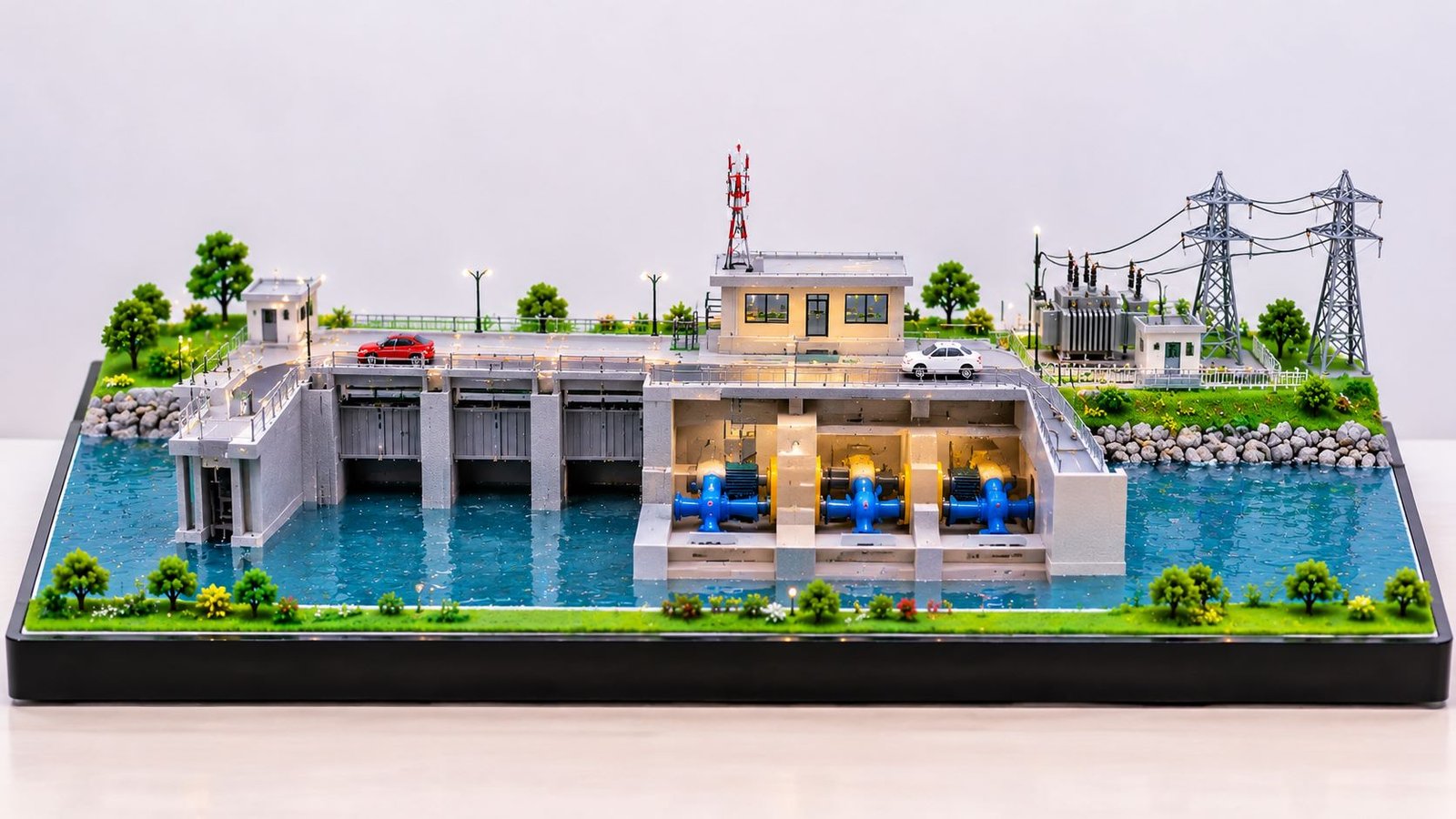
A detailed physical model brings together several important components, including a tidal barrage, sluice gates, water channels, turbine chambers, generators, transformers and transmission towers. In addition, the model can feature a control building, maintenance platforms, coastal protection and access roads.
Such an engineering model helps students, technical institutions, project developers and industry professionals understand how a tidal power generation facility operates. Moreover, it provides an effective visual presentation for renewable energy exhibitions, technical demonstrations and infrastructure projects.
Understanding Tidal Power Plant Technology
A tidal power plant converts energy from ocean tides into electricity. The regular movement of seawater creates opportunities to capture potential energy and kinetic energy.
Engineers use different technologies to collect this energy. Some facilities control water levels through a barrage, while others install underwater turbines in locations with strong tidal currents.
Tidal Range Power Generation System
Tidal range technology uses the difference between high-tide and low-tide water levels.
A barrage or tidal lagoon creates a controlled difference in water levels. When seawater passes through specially designed turbine passages, it rotates the turbine runner. Consequently, the connected generator produces electricity.
This arrangement forms the main engineering concept behind a tidal barrage power plant.
Tidal Stream Power Generation System
Tidal stream technology captures the kinetic energy of moving seawater.
Engineers install underwater turbines in locations where tidal currents provide suitable flow conditions. The moving water rotates the turbine blades. Meanwhile, the connected generator converts rotational movement into electrical power.
Unlike a barrage system, tidal stream technology does not require a large dam-like structure across an estuary.
Both technologies demonstrate the potential of marine renewable energy. However, their structural arrangements and engineering requirements are different.
Overall Design of a Tidal Power Plant Model
The overall design of a tidal power plant model should represent the relationship between the coastal environment, water movement and electrical generation equipment.
A wide rectangular layout provides sufficient space for the main barrage, turbine chambers, water channels and surrounding electrical infrastructure. Moreover, this arrangement allows viewers to understand the complete plant without hiding important components.
The central area generally contains the tidal barrage and powerhouse. On one side, the model can show the incoming water channel. On the other side, it can represent the outgoing water channel and coastal landscape.
The electrical substation and transmission equipment occupy a separate land-based section. In addition, the control building connects the operational and electrical systems.
Main Structural Arrangement of the Tidal Energy Model
The tidal barrage forms the main structural element of the model. It includes concrete walls, multiple water passages, sluice gates and turbine openings.
The powerhouse connects with the barrage and contains the main mechanical equipment. A cutaway section can reveal the turbine runners, generator housings, shafts and supporting structures.
Above the powerhouse, the model can feature a service road, inspection walkways, safety railings and maintenance platforms.
A separate control building represents the operational area. Meanwhile, the electrical substation connects the generator system to the transmission network.
The surrounding landscape can include rocky embankments, coastal vegetation, utility buildings and access roads. These features provide a realistic infrastructure appearance while keeping the main engineering structures visible.
Major Components of a Tidal Power Plant Model
A tidal power generation facility contains several interconnected systems. Each component performs a specific function, from controlling seawater movement to delivering electricity to the grid.
Tidal Barrage Structure
The tidal barrage controls water movement between the sea and a tidal basin. Engineers generally construct this structure across a suitable coastal inlet, estuary or bay.
The barrage maintains the required water-level difference and provides controlled passages for seawater. Therefore, it plays an important role in tidal range power generation.
A physical engineering model should clearly show the concrete structure, support columns, water openings and turbine sections.
Important structural details include:
- Reinforced concrete walls
- Water passage openings
- Turbine housing sections
- Sluice gate assemblies
- Inspection platforms
- Maintenance walkways
- Structural support columns
- Safety railings
These details help viewers understand the size and structural arrangement of the barrage.
Sluice Gate System
Sluice gates regulate water movement through the barrage. The control system opens or closes these gates according to tidal conditions and the plant’s operating requirements.
During suitable tidal conditions, the gates allow seawater to enter or leave the basin. As a result, the plant can manage the water movement required for power generation.
A detailed model can include vertical gate panels, guide rails, lifting mechanisms and supporting frames.
Gate Operating Mechanism
Different power plants use different gate operating arrangements. These may include hydraulic cylinders, electric actuators or mechanical lifting systems.
The physical model can show miniature lifting equipment above the gate openings. In addition, supporting beams and access platforms improve the technical appearance.
Reversible Tidal Turbine System
Tidal turbines convert the energy of moving seawater into rotational mechanical energy.
In a suitable barrage-based power plant, reversible turbines can generate electricity during incoming and outgoing tidal flows. However, the exact operating arrangement depends on the turbine design and plant configuration.
The turbine section deserves special attention because it represents the main mechanical energy conversion system.
A detailed turbine assembly can include:
- Turbine runner
- Rotating blades
- Turbine shaft
- Turbine casing
- Guide vanes
- Bearings
- Mechanical coupling
- Generator connection
The turbine chamber should remain clearly visible in the physical scale model.
Turbine Chamber Arrangement
The powerhouse contains separate turbine passages and equipment chambers. Each chamber connects the water passage with its turbine assembly.
A cutaway design allows viewers to see the internal mechanical arrangement. Furthermore, different surface finishes can distinguish the turbine housing, rotating components and support structures.
Generator Assembly
The generator converts mechanical energy from the rotating turbine into electrical energy.
The turbine shaft transfers rotational movement to the generator rotor. Electromagnetic induction then produces electrical power inside the generator.
A realistic model should include generator housings, shaft connections and equipment supports.
The main generator components include:
- Generator casing
- Rotor assembly
- Stator housing
- Shaft coupling
- Bearing supports
- Cooling arrangement
- Electrical terminals
These details help explain how the mechanical and electrical systems connect. Therefore, the generator section should remain visible rather than being completely covered by the powerhouse structure.
Powerhouse Structure
The powerhouse contains the main turbine and generator equipment. It also provides space for maintenance activities, electrical connections and auxiliary machinery.
The physical model can represent a concrete foundation, equipment chambers, internal service corridors and maintenance platforms.
An open cutaway section offers a better view of the internal machinery. Meanwhile, the upper building can represent the operational and service facilities.
The arrangement should also show how the turbine chambers connect with the main water passages.
Hydraulic Water Channels
Water channels guide seawater between the marine environment, tidal basin and turbine passages.
Their shape and dimensions depend on the hydraulic design of the project. Engineers consider flow velocity, water depth, hydraulic head and energy losses when designing these passages.
A physical model should show clearly defined water channels with concrete boundaries and natural-looking coastal surfaces.
The water surface should remain at a realistic level. In addition, the channel arrangement should clearly connect with the barrage and turbine openings.
Transformer and Electrical Substation
The generator produces electricity, but the power system also needs equipment to control and transmit that electricity.
A transformer changes the voltage to the required level for the transmission network. Similarly, the electrical substation provides switching, protection and control functions.
Important substation components include:
- Power transformer
- High-voltage bushings
- Circuit breakers
- Isolators
- Busbars
- Current transformers
- Voltage transformers
- Protection equipment
- Electrical cable connections
A miniature substation adds important electrical engineering details to the overall model.
Power Transmission Towers
Transmission towers carry electricity from the generating facility toward the wider electrical grid.
A detailed scale model can include lattice steel towers, cross-arms, insulators and overhead conductors.
The towers should connect visually with the substation area. Consequently, viewers can understand the relationship between electricity generation and power transmission.
Control Room and Monitoring Building
The control room monitors the performance of the tidal power plant.
Modern facilities use automation and monitoring equipment to manage turbine speed, water levels, gate positions, generator output and electrical protection systems.
A miniature control building can include glazed windows, internal lighting, control panels and operational areas.
Furthermore, the building helps demonstrate how engineers monitor different sections of the facility.
Working Principle of a Tidal Power Generation System
The working principle of a tidal power plant depends on the movement of seawater and the difference between water levels.
A barrage-based facility controls this movement and directs water through turbines to generate electricity. The complete process involves several connected stages.
High Tide and Water Level Management
During high tide, the sea level rises and seawater approaches the tidal barrage.
Depending on the operating arrangement, the control system allows water to enter the basin through sluice gates or turbine passages.
The plant monitors the water level on both sides of the barrage. Therefore, operators can select a suitable time for power generation.
Water Flow Through Turbines
When a suitable water-level difference develops, seawater moves through the turbine passages.
The moving water applies force to the turbine runner and causes it to rotate. Consequently, the turbine converts hydraulic energy into mechanical energy.
The turbine design determines how efficiently the system captures this energy.
Mechanical Energy Conversion
The rotating turbine shaft transfers mechanical power to the generator through a coupling arrangement.
Bearings support the shaft, while the mechanical assembly maintains stable rotation.
At this stage, hydraulic energy has become mechanical energy. This connection demonstrates the relationship between hydraulic engineering and mechanical engineering.
Electrical Power Generation
The generator converts rotational mechanical energy into electrical energy through electromagnetic induction.
The electrical output depends on several factors, including water flow, hydraulic head, turbine efficiency and generator performance.
After generation, electrical cables transfer the power toward the plant’s electrical equipment.
Voltage Transformation and Grid Connection
The transformer adjusts the voltage according to transmission requirements.
Next, the electrical substation manages switching and protection before the power enters the grid.
Finally, transmission lines carry electricity toward distribution networks and consumers. Thus, the system completes the main energy conversion process.
Ebb Generation and Flood Generation Systems
Tidal power plants can use different operating methods depending on their design. These methods determine the direction of water flow and the way turbines generate electricity.
Ebb Generation
Ebb generation takes place when seawater flows from the tidal basin toward the sea as the tide falls.
The difference in water level creates the hydraulic head required for turbine operation.
As water passes through the turbine passages, the rotating runners drive the generators and produce electricity. Therefore, the system captures energy during the outgoing tidal movement.
Flood Generation
Flood generation occurs when incoming seawater moves from the sea toward the tidal basin.
A suitable turbine arrangement captures the energy of this incoming flow and converts it into electricity.
This operating method uses the movement of seawater during the rising tide.
Two-Way Generation
Two-way generation allows a suitable turbine system to produce electricity during both incoming and outgoing tidal flows.
Reversible turbines support this operating method in certain power plant designs.
However, not every tidal power facility uses two-way generation. The final operating method depends on the turbine technology and project requirements.
Engineering Disciplines Used in Tidal Power Plant Development
Tidal power development requires coordination between different engineering disciplines. Each discipline contributes to the design, construction and operation of the facility.
Civil and Structural Engineering
Civil engineers design the barrage, foundations, water passages, concrete structures and supporting infrastructure.
Structural engineers also consider water pressure, wave loading, environmental conditions and equipment loads.
The physical model represents these elements through the concrete barrage, structural walls and foundation arrangement. In addition, it shows how the different structures connect.
Mechanical Engineering
Mechanical engineers work on turbine assemblies, generator connections, shafts, bearings and auxiliary equipment.
The turbine chamber represents one of the most important mechanical sections of the model.
Its cutaway arrangement helps explain how moving water produces rotational movement. Moreover, it demonstrates the mechanical connection between the turbine and generator.
Electrical Engineering
Electrical engineers handle generators, transformers, switchgear, protection systems and transmission connections.
They also develop electrical arrangements that safely transfer power from the generator toward the grid.
The electrical section of the model helps explain the complete power transmission arrangement.
Marine Engineering
Marine engineers focus on the relationship between the power plant and its surrounding marine environment.
Their work includes water movement, coastal structures, navigation requirements, marine equipment and environmental conditions.
Therefore, the marine section plays an important role in the overall project design.
Instrumentation and Control Engineering
Instrumentation engineers monitor important operating parameters such as water levels, pressure, flow rate, turbine speed and generator temperature.
Furthermore, automated control systems help coordinate the operation of gates, turbines and electrical equipment.
These systems improve operational monitoring and support the safe operation of the facility.
Physical Scale Model Making for Tidal Energy Projects
A professional Tidal Power Plant Model requires proper planning, accurate proportions and careful component placement.
The objective is to represent the actual engineering facility in a clear three-dimensional format. At the same time, the model should maintain a realistic physical appearance.
Baseboard and Overall Layout
The baseboard provides the foundation for the complete model.
A wide rectangular baseboard works well for tidal energy projects because the facility contains long water channels, a central barrage and separate electrical infrastructure.
The main powerhouse should occupy a prominent position. Meanwhile, the surrounding water and coastal sections should maintain a balanced layout.
A clean baseboard with finished edges also improves the professional presentation.
Structural Model Construction
The barrage, powerhouse and control building require suitable model-making materials.
Acrylic, PVC sheets, MDF, foam boards and other fabrication materials can help create different structural elements.
Model makers can use different surface textures to represent concrete, metal, glass and other construction materials. As a result, each part of the model becomes easier to identify.
Turbine and Mechanical Equipment Detailing
The turbine assembly should remain visible wherever possible.
Miniature turbine blades, generator housings, shaft connections and equipment supports help explain the mechanical arrangement.
In addition, small details such as bolts, flanges, pipes, brackets and maintenance platforms improve the overall appearance.
The cutaway section should provide a clear view of the turbine and generator without unnecessary visual obstruction.
Water Surface and Coastal Landscaping
The water channels should have a natural blue finish with a consistent surface level.
Rock protection, embankments, coastal vegetation and access roads provide the surrounding environmental context.
However, landscaping should not hide the main engineering structures. Instead, it should support the overall presentation.
Electrical Infrastructure Detailing
The electrical section can include transformers, switchgear, transmission towers, insulators and connecting conductors.
These elements complete the visual representation of the power generation and transmission system.
Similarly, miniature cable connections and equipment foundations can improve the level of technical detailing.
Lighting and Final Presentation
Miniature LED lights can highlight the powerhouse, control room, roads and selected equipment.
However, lighting should improve visibility rather than distract from the engineering details.
The final model should allow viewers to identify the barrage, turbine chambers, generator assemblies and electrical infrastructure from normal viewing angles.
Materials and Techniques for Tidal Energy Scale Model Making
Material selection depends on the project dimensions, design complexity and required presentation quality.
Different materials support different fabrication requirements. Therefore, model makers often combine several techniques to achieve the desired finish.
Acrylic and Transparent Materials
Acrylic sheets work well for windows, selected transparent panels and protective sections.
They also provide a clean surface finish and help viewers see certain internal components.
PVC and Foam-Based Materials
PVC sheets and foam-based materials offer lightweight options for buildings, walls, structural panels and equipment enclosures.
Model makers can cut and shape these materials to achieve the required dimensions.
Moreover, suitable surface treatments can give them a realistic concrete or metal appearance.
3D Printed Components
3D printing helps produce complex mechanical components with detailed shapes.
For example, model makers can create turbine runners, equipment housings, pipes, mechanical covers and customized fittings.
This technique also supports the production of components that require consistent dimensions. Consequently, it is useful for detailed engineering model fabrication.
Laser Cutting and Precision Fabrication
Laser cutting helps create accurate structural panels, platforms, equipment supports and repeated components.
Furthermore, it provides consistent edges and improves the overall quality of fabricated parts.
Combining these techniques allows the model maker to create a realistic engineering presentation.
Applications of Tidal Energy Power Plant Models
Tidal energy models support several educational, technical and professional applications. They help explain complex engineering arrangements through a physical representation.
Engineering College Projects
Engineering students can use these models to understand hydraulic turbines, power generation, marine structures and electrical systems.
They also provide a practical way to explain renewable energy concepts during academic presentations.
In addition, students can demonstrate how different engineering disciplines contribute to a complete power plant.
Renewable Energy Exhibitions
Renewable energy exhibitions bring different clean energy technologies together.
A physical tidal energy model helps visitors understand how ocean movements generate electricity. Moreover, it provides a useful comparison with solar, wind and hydroelectric technologies.
Infrastructure Project Presentations
Project developers and engineering consultants can use scale models to present proposed coastal energy infrastructure.
The physical arrangement helps clients understand the location of major structures and the relationship between different facilities.
As a result, project teams can explain technical arrangements more clearly during presentations.
Research and Technical Demonstrations
Research institutions can use tidal power models to explain marine energy concepts, turbine arrangements and hydraulic systems.
Similarly, technical demonstrations can help communicate complex engineering information to a wider audience.
Industrial and Corporate Displays
Companies working in energy, marine engineering and infrastructure can use customized models for exhibitions, technical meetings and corporate presentations.
Furthermore, these models provide a visual representation of industrial and engineering capabilities.
Advantages of Tidal Energy Generation
Tidal energy offers several useful characteristics for renewable energy development. These advantages make it an interesting technology for suitable coastal regions.
Predictable Energy Resource
Tidal movements follow predictable astronomical cycles.
Therefore, engineers can estimate tidal conditions and plan power generation around expected water movements.
However, the actual electricity output still depends on the tidal cycle and the design of the power plant.
Renewable Source of Energy
Tidal energy uses naturally occurring ocean movements.
Unlike fossil-fuel power generation, the process does not require continuous fuel combustion to produce electricity.
Consequently, tidal power can contribute to the development of cleaner energy systems.
Long-Term Infrastructure Potential
Engineers can design tidal infrastructure for long operating periods.
Nevertheless, the plant requires regular maintenance, corrosion protection and structural inspection.
Proper planning can help maintain the performance of the facility throughout its operating life.
Reduced Direct Operational Emissions
Tidal electricity generation does not involve direct fossil-fuel combustion during normal operation.
As a result, it can contribute to lower operational greenhouse gas emissions compared with conventional fossil-fuel generation.
Contribution to Energy Diversification
Tidal energy can support a broader renewable energy mix.
In coastal regions with suitable conditions, it can complement other renewable sources and contribute to long-term energy planning.
Challenges in Tidal Energy Power Plant Development
Although tidal power offers several benefits, engineers must address important challenges before developing a commercial facility.
High Initial Construction Cost
Tidal barrage projects require large civil structures, marine construction equipment, turbines and electrical infrastructure.
Consequently, the initial investment can be significant.
Environmental Considerations
Tidal structures can affect marine habitats, sediment movement, water quality and aquatic migration patterns.
Therefore, developers must evaluate environmental conditions before selecting a project location.
Location Requirements
Not every coastal location provides suitable conditions for tidal power generation.
Engineers need to examine tidal range, current velocity, seabed conditions, coastal geography and grid connectivity.
In addition, project developers must consider the availability of suitable construction and maintenance facilities.
Maintenance in Marine Conditions
Saltwater, corrosion, waves and changing weather conditions can affect marine equipment.
For this reason, engineers must select suitable materials and develop regular inspection and maintenance plans.
Grid Integration
Tidal generation follows predictable but changing tidal cycles.
Power system operators must consider generation schedules, grid management and suitable energy storage solutions where required.
Thus, proper electrical planning is important for successful grid integration.
Difference Between Tidal Energy, Wave Energy and Hydroelectric Power
These three technologies use water to produce electricity. However, they rely on different energy sources and engineering systems.
Tidal Energy
Tidal energy uses the rise and fall of sea levels or the movement of tidal currents.
A barrage or underwater turbine captures the available energy and converts it into electrical power.
Wave Energy
Wave energy uses the movement of ocean surface waves.
Different technologies, including floating devices and oscillating water columns, capture wave movement and convert it into electricity.
Hydroelectric Power
Hydroelectric power generally uses flowing or stored freshwater.
A dam or reservoir creates the water head required to drive hydraulic turbines and generators.
Therefore, a Tidal Power Plant Model should represent the marine environment, tidal barrage and coastal water channels rather than simply resembling a conventional hydroelectric dam.
Modern Technologies Used in Tidal Power Generation
Engineering improvements continue to support the development of marine renewable energy systems.
Advanced Turbine Technology
Modern tidal turbines use improved blade designs and mechanical arrangements to capture energy from moving seawater.
Blade geometry, rotor diameter, rotational speed and material selection influence overall performance.
Moreover, engineering research continues to explore ways to improve turbine efficiency and reduce maintenance requirements.
Automated Gate Control
Automated gate systems help regulate water movement according to tidal conditions.
Sensors and control equipment monitor water levels and gate positions. Consequently, operators can coordinate the movement of water with turbine operation.
Smart Monitoring Systems
Modern monitoring systems collect operating information from turbines, generators and structural equipment.
Engineers can use this information to identify equipment problems and plan maintenance activities.
Furthermore, automated monitoring can help operators observe the condition of different plant sections.
Corrosion-Resistant Materials
Marine environments require equipment that can withstand saltwater and changing weather conditions.
Suitable alloys, protective coatings and composite materials help improve equipment durability.
As a result, material selection becomes an important part of tidal power plant engineering.
Digital Engineering and Simulation
Digital engineering tools help engineers study hydraulic flow, structural loading, turbine performance and electrical integration.
These tools support the design process before construction begins.
A physical scale model complements digital simulation by showing the overall infrastructure in a clear three-dimensional arrangement.
Professional Presentation of a Tidal Power Plant Model
A professional engineering model should communicate the complete project arrangement without unnecessary visual elements.
The barrage and powerhouse should remain the main focus. At the same time, the turbine chambers and electrical equipment should remain visible from the viewing side.
The water channels should connect clearly with the turbine passages. Moreover, the electrical substation should have a logical position near the power generation facilities.
Realistic concrete finishes, miniature railings, equipment supports, service roads and mechanical detailing improve the overall presentation.
An open cutaway section can also reveal the internal machinery without removing the complete building structure.
For larger engineering presentations, model makers can include removable roof sections or selected open panels. These features help viewers understand the internal arrangement more easily.
Finally, the design should reflect the project requirements, technical drawings and intended presentation purpose.
Importance of Professional Engineering Scale Model Making
Engineering scale models help communicate complicated infrastructure through physical three-dimensional representations.
Technical drawings explain dimensions and layouts. However, a physical model makes it easier to understand how different structures and equipment connect.
This becomes particularly useful for renewable energy projects because they combine civil structures, mechanical machinery, electrical systems and environmental infrastructure.
A professionally developed tidal energy model brings these elements together in one presentation.
Accurate proportions, clear component placement, realistic finishes and visible internal machinery all contribute to the final result.
Therefore, professional model making plays an important role in engineering presentations, technical demonstrations and project visualization.
PAL Design Models – Engineering and Industrial Scale Model Making
PAL Design Models provides customized engineering and industrial scale model-making services for technical presentations, infrastructure projects, exhibitions and project visualization.
Engineering facilities often contain complex structures and interconnected systems. Physical models help present these arrangements in a way that clients, engineers and other stakeholders can understand.
A tidal energy power plant model involves several technical elements, including marine structures, hydraulic systems, turbine assemblies, generators and electrical transmission infrastructure.
PAL Design Models can develop customized physical representations according to project drawings, dimensions, technical requirements and presentation objectives.
The company’s model-making service categories include:
- Architectural Model Making
- Mechanical Engineering Models
- Civil Engineering Models
- Electrical Engineering Models
- Industrial Plant Models
- Power Plant Scale Models
- Renewable Energy Models
- Marine Engineering Models
- Hydraulic System Models
- Working Engineering Models
- Infrastructure Scale Models
- 3D Printing Services
- Laser Cutting Services
Each project requires a suitable approach to structural design, component fabrication and presentation.
For more information about customized engineering and industrial model-making services, visit the official website.
Website: https://paldesignmodels.com/
Conclusion
A Tidal Power Plant Model provides a clear three-dimensional representation of how ocean movements can generate electrical power.
The model combines several important engineering systems, including tidal barrage structures, sluice gates, reversible turbines, generator assemblies, powerhouse buildings, electrical substations and transmission towers.
Each component contributes to the complete energy conversion process. Together, these systems demonstrate how hydraulic energy becomes mechanical energy and finally electrical energy.
A professional physical model also helps explain the relationship between marine infrastructure and power generation equipment.
Careful planning, accurate proportions, visible turbine assemblies, realistic water channels and detailed electrical infrastructure all improve the quality of the final presentation.
As renewable energy development continues, tidal power remains an important subject for engineering education, technical research and infrastructure planning.
Ultimately, a well-designed physical scale model makes this technology easier to understand and provides a valuable presentation tool for engineering students, professionals, project developers and renewable energy organizations.