Solar Power Plant Engineering Model: Guide to Design, Components, Working and Infrastructure
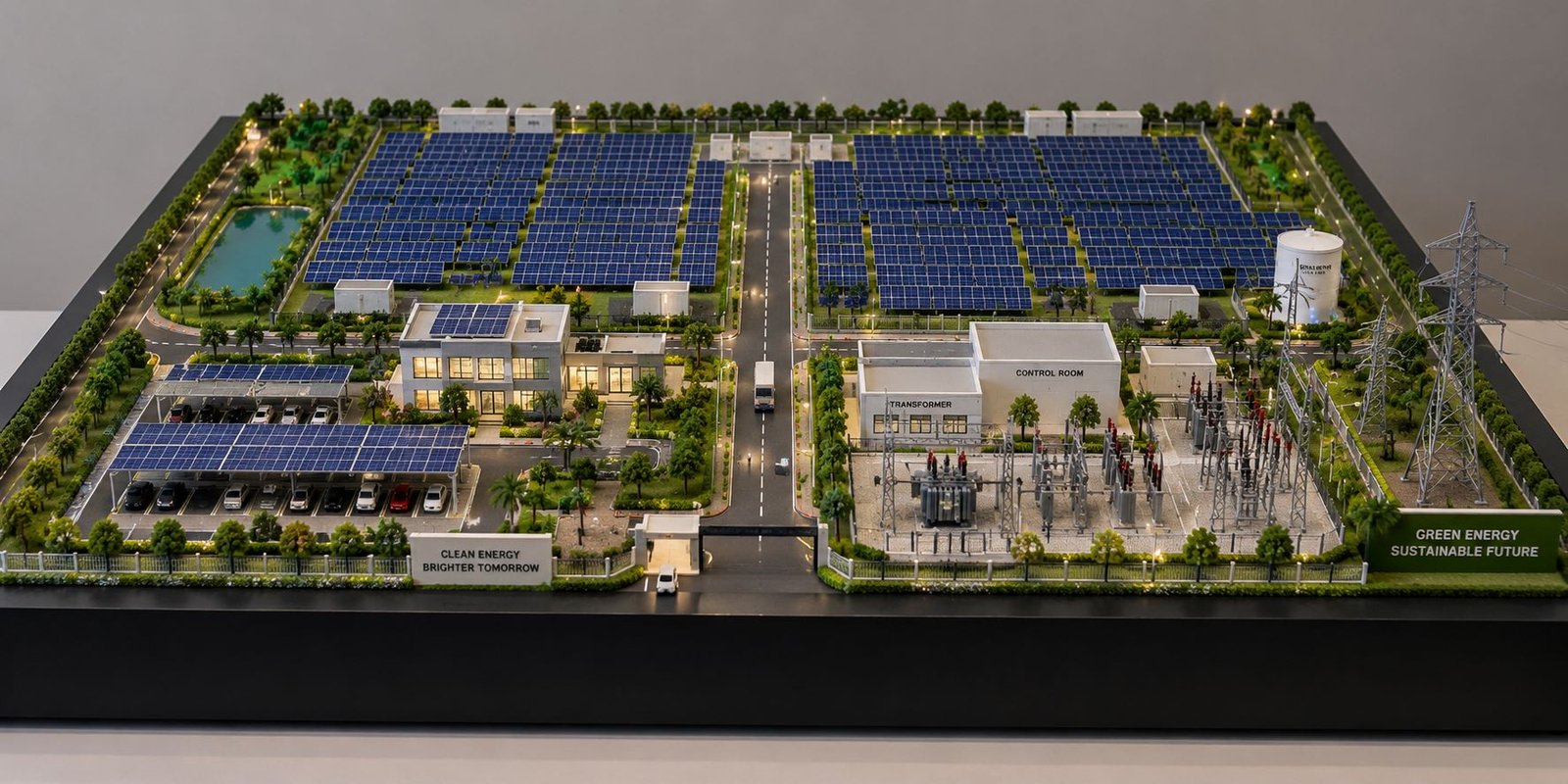
A solar power plant is a large-scale renewable energy facility that harnesses sunlight and converts it into electrical energy using photovoltaic (PV) technology. The solar power plant engineering model depicted in the image represents a complete grid-connected solar photovoltaic power plant, comprising solar PV modules, mounting structures, inverters, transformers, switchgear, switchyard, control room, internal roads, security fencing, lighting and supporting infrastructure.
Unlike a simple solar panel demonstration, this industrial model of a solar power plant showcases the complete journey of electricity from sunlight striking the photovoltaic modules to its conversion, transformation and protection, followed by its transmission to the electrical grid.
Such an engineering model is an excellent way to understand the integration of renewable energy technology with electrical, civil, structural, mechanical, instrumentation and automation engineering.
Overview of the Solar Power Plant Model
The industrial engineering model is broadly divided into a solar generation area, electrical conversion and transformation area, high-voltage switchyard, control and operational buildings and supporting civil infrastructure.
The large arrays in blue represent the solar PV modules that capture sunlight and generate DC electricity. The electrical equipment between the PV field and switchyard represent systems such as inverters, transformers, switchgear and electrical collection equipment.
The switchyard is the major high-voltage section of the facility that houses equipment used for switching, protection, measurement and transferring generated electricity towards the grid.
The buildings around the plant can represent the control room, operation and maintenance facilities, administrative areas and security infrastructure.
The complete model therefore provides a visual representation of a modern utility-scale solar power plant layout.
Solar Photovoltaic Modules
Solar PV modules are the primary electricity-generating components of the plant. Each module comprises photovoltaic cells that convert solar radiation directly into electrical energy using the photovoltaic effect.
In a utility-scale installation, multiple modules are tied together to create PV strings. Several such PV strings can be combined to form larger PV generation blocks.
The large, organized rows of solar panels visible in the model demonstrate how photovoltaic modules are laid out across the available land.
The design of a PV array is done considering a variety of factors such as solar irradiation, module efficiency, orientation, tilt angle, row spacing, shading, land availability, inverter capacity and environmental conditions.
Proper arrangement is essential as the PV field needs to attain high energy generation while ensuring sufficient space for maintenance access and minimizing between-row shading.
Solar Module Mounting Structure
PV modules are mounted on specially-designed solar mounting structures that ensure mechanical support and the required orientation.
A solar plant can feature fixed-tilt structures or tracking systems. Fixed-tilt structures keep the modules at a predetermined angle, while tracking systems are able to change their position according to the movement of the sun.
The mounting structure is an important aspect of the structural engineering design that needs to withstand wind loads, environmental exposure, temperature variations and site-specific soil conditions.
Foundations are also designed according to the characteristics of the site. The complete mounting system needs to ensure long-term mechanical stability while protecting the PV modules from excessive motion or structural stress.
DC Power Collection System
Solar modules initially produce direct-current electricity. This direct-current (DC) power needs to be collected and transferred to the inverter system safely.
The DC collection network can comprise PV string cables, connectors, combiner boxes, fuses, DC isolators, surge protection devices, underground cables and cable-management systems.
Multiple PV strings are fused together and routed towards the inverter stations. Proper electrical design is necessary to manage voltage drop and minimize energy losses.
Cable-sizing, current-carrying capacity, operating temperature, installation method and system voltage are important considerations when designing the solar PV electrical system.
Solar Inverter System
The solar inverter is a critical component since photovoltaic modules produce DC electricity while the electrical grid operates using AC electricity.
The inverter converts the generated DC power into AC:
Solar PV Modules → DC Electricity → Inverter → AC Electricity
Modern solar inverters can also provide monitoring, control and protection functionality. They can measure parameters such as voltage, current, frequency, active power and reactive power.
Utility-scale plants can use central inverter systems or distributed string inverter configurations. The appropriate configuration choice depends on the plant capacity, site conditions, electrical design and maintenance strategy.
The model has the electrical equipment between the solar field and the large switchyard that represents this important power-conversion stage.
Step-Up Transformer
After conversion from DC to AC, the generated electricity generally passes through a step-up transformer.
The transformer increases the voltage to a suitable level for efficient electrical transmission through the plant’s high-voltage network.
The simplified power-flow can be represented as:
PV Array → Inverter → Step-Up Transformer → Switchgear → Switchyard → Grid
Transformers are therefore an essential component of the electrical balance-of-system in a utility-scale solar power plant.
Large transformers also require protection, cooling, insulation, monitoring and regular maintenance to ensure reliable operation.
Solar Power Plant Switchyard
The large electrical equipment area shown in the center-right portion of the model represents the solar plant switchyard.
The switchyard provides the electrical interface between the solar generation system and the external transmission or distribution network.
Typical switchyard equipment comprises:
- Circuit Breakers
- Isolators or Disconnectors
- Busbars
- Current Transformers
- Voltage Transformers
- Lightning Arresters
- Protection Relays
- Metering Equipment
- Earthing Systems
- Control and Communication Equipment
The switchyard facilitates the control, connection, disconnection and isolation of electrical circuits safely during normal operation and maintenance.
High-Voltage Switchgear and Protection
High-voltage switchgear protects the electrical network from abnormal operating conditions.
Circuit breakers can interrupt current during electrical faults while isolators provide electrical isolation for maintenance activities.
Protection systems can respond to conditions such as short circuits, earth faults, overcurrent, overvoltage, undervoltage and other abnormal electrical events.
Protection relays continually monitor electrical parameters and help isolate faulty sections without unnecessarily shutting down the entire facility.
The combination of switchgear, protection relays, transformers, CTs, PTs and busbars together constitute an essential part of the high-voltage infrastructure of the plant.
Solar Plant Control Room
The control room serves as the operational center of the solar power plant.
Operators can monitor the performance and condition of different plant systems from centralized workstations.
Important parameters can include:
- Solar Power Generation
- Inverter Status
- Transformer Condition
- Voltage and Current
- Frequency
- Active and Reactive Power
- Energy Generation
- Switchgear Status
- Equipment Alarms
- Weather Conditions
The control room depicted in the model represents how modern renewable energy facilities use centralized monitoring and control to manage complex electrical infrastructure.
SCADA and Monitoring System
A modern solar power plant typically utilizes SCADA (Supervisory Control and Data Acquisition) for monitoring and operational management.
SCADA collects information from inverters, transformers, switchgear, meters, weather stations and other intelligent devices.
The system can monitor solar irradiance, ambient temperature, module temperature, wind speed, DC voltage, DC current, AC voltage, AC current, power output and equipment status.
This information enables plant operators and engineers to identify faults, analyze performance and respond to abnormal conditions.
SCADA therefore bridges solar power generation with industrial automation and digital monitoring.
Solar Plant Single-Line Diagram
The electrical architecture of a solar power plant is commonly represented by a Single-Line Diagram (SLD).
The simplified electrical flow is as follows:
PV Modules
↓
PV Strings
↓
DC Collection System
↓
Solar Inverter
↓
AC Collection System
↓
Step-Up Transformer
↓
HT Switchgear
↓
Solar Switchyard
↓
Grid Interconnection
A single-line diagram is an important engineering document used during system design, equipment selection, protection coordination, commissioning and maintenance.
When combined with a solar power plant engineering model, students can understand the physical layout of the facility as well as the electrical power-flow of the plant.
Grid Interconnection and Power Evacuation
The ultimate aim of a grid-connected solar power plant is to transfer the generated electricity to the wider electrical network.
After passing through the inverter, transformer and switchyard, electricity reaches the grid interconnection point.
The power evacuation system can comprise high-voltage cables, transmission lines, grid bays, protection systems, metering equipment, communication systems and associated substation infrastructure.
Grid connectivity is a major consideration during solar plant planning since the generation capacity, voltage level and transmission requirements directly impact the electrical design.
Civil Engineering Infrastructure
A large solar power plant is not only an electrical installation. Civil engineering plays an equally important role in its construction and operation.
Major civil works can comprise land grading, site preparation, foundations, internal roads, drainage systems, equipment foundations, cable trenches, buildings, switchyard foundations, fencing and security gates.
The model demonstrates this integration by showcasing the solar arrays along with roads, buildings, landscaping and boundary infrastructure.
Proper civil design provides the stable foundation and accessibility required for long-term plant operation.
Internal Roads and Site Layout
The internal roads depicted in the model are an integral component of the solar plant layout.
Construction equipment, maintenance vehicles and emergency vehicles need access to different PV blocks, inverter stations, transformers, switchyard equipment and buildings.
The spacing between solar panel rows also needs to be planned to minimize shading and provide adequate maintenance access.
An efficient site layout considers land utilization, solar radiation, cable lengths, drainage, access roads, electrical losses, construction requirements and long-term operation and maintenance.
Earthing and Lightning Protection
Electrical safety is a major concern in a high-voltage solar power plant.
A properly-designed earthing and grounding system provides a safe path for fault currents and helps protect personnel and equipment.
PV structures, inverters, transformers, switchgear, control panels, switchyard structures and buildings may need appropriate grounding connections.
Lightning protection is also important since large solar facilities have extensive outdoor electrical infrastructure.
Lightning arresters, grounding networks and appropriate protection arrangements can help minimize the risk of lightning-related equipment damage.
Security and Boundary Infrastructure
The model also showcases perimeter fencing, controlled access and security infrastructure.
A utility-scale solar facility covers a large area and contains valuable electrical equipment, thus controlled access becomes important.
A solar plant can comprise security gates, security cabins, CCTV surveillance, access-control systems and perimeter lighting.
Restricting unauthorized access becomes particularly important around high-voltage equipment and switchyard areas.
Operation and Maintenance of a Solar Power Plant
After construction and commissioning, the plant requires continuous operation and maintenance (O&M).
Regular maintenance aids in maintaining energy production, equipment reliability and plant availability.
Typical activities can include PV module cleaning, visual inspections, inverter maintenance, transformer inspection, switchgear testing, cable inspection, thermographic testing, earthing checks, vegetation management, drainage maintenance and SCADA monitoring.
Dust accumulation on solar modules reduces the amount of sunlight reaching the photovoltaic cells. Therefore, cleaning schedules and performance monitoring can become important, especially in dusty environments.
Preventive maintenance helps in identifying potential equipment problems before they develop into major failures.
Solar Power Plant Performance
The energy output of a solar power plant is dependent on a number of technical and environmental factors.
Solar irradiance determines the amount of sunlight available for electricity generation.
PV module efficiency dictates how effectively the available sunlight is converted into electrical energy.
Temperature impacts photovoltaic performance and must be taken into consideration during plant design and energy-yield calculations.
Shading can reduce the output of the affected modules, thus appropriate panel spacing and layout becomes essential.
Soiling due to dust and dirt can impact energy production.
Electrical losses can occur in DC cables, AC cables, transformers, inverters and other equipment. Plant availability is also crucial since equipment downtime directly impacts electricity generation.
Engineering Disciplines Behind a Solar Power Plant
A utility-scale solar plant is a multidisciplinary engineering project.
Electrical engineering covers PV system design, DC and AC networks, inverters, transformers, switchgear, protection, earthing, metering, cables and grid interconnection.
Civil engineering covers land development, grading, foundations, roads, drainage, buildings and cable trenches.
Structural engineering is involved in solar mounting structures and equipment supports.
Mechanical engineering contributes to mounting systems, tracking systems and equipment installation.
Instrumentation and automation engineering covers SCADA, sensors, communication systems, monitoring and control.
The successful integration of all these disciplines transforms a solar site into a complete industrial power-generation facility.
Solar Power Plant as an Industrial Engineering Model
The model depicted in the image can be used as an industrial model, engineering exhibition model, renewable energy project model, educational model or solar power plant project.
It provides a visual representation of how individual components operate as one integrated system.
The model can be used to explain the complete power-generation sequence:
Solar Energy → PV Generation → DC Power Collection → Inverter Conversion → AC Power → Voltage Transformation → Switchgear → Switchyard → Grid Transmission
For engineering students, this type of model makes complex concepts easier to understand by connecting theoretical electrical diagrams with a physical representation of the plant.
It can also be used for technical exhibitions, engineering colleges, academic presentations, renewable energy demonstrations and industrial training.
Advantages and Challenges of Solar Power Plants
Solar power plants leverage sunlight as a renewable energy resource and can contribute to large-scale renewable electricity generation.
Photovoltaic systems are also modular, thus large generation capacity can be achieved by combining multiple PV blocks and electrical systems.
However, solar generation is dependent on sunlight and thus varies according to the time of day and weather conditions. Large projects also require appropriate land, grid connectivity, electrical infrastructure and long-term maintenance.
Dust, high temperatures, shading, equipment degradation and electrical faults can impact performance. Effective engineering design, monitoring and preventive maintenance are therefore essential for reliable operation.
Complete Working of the Solar Power Plant
The complete operation of the plant begins when sunlight reaches the solar PV modules installed across the generation field.
The photovoltaic cells in the modules convert solar radiation into DC electricity. This electricity is collected through PV strings and DC collection equipment and delivered to the inverter system.
The solar inverter converts DC electricity into AC electricity. The AC output is then transferred through the electrical collection system towards the step-up transformer.
The transformer increases the voltage to an appropriate level for the plant’s high-voltage network.
The electricity then reaches the switchgear and switchyard, where protection, switching, isolation and metering systems manage the electrical power.
Finally, the generated electricity is transferred through the grid interconnection and power evacuation system towards the external electrical network.
At the same time, the control room and SCADA system continually monitor the plant’s electrical parameters, equipment status and energy generation.
Conclusion
The solar power plant engineering model depicted in the image represents a complete utility-scale grid-connected photovoltaic power generation system. The large PV field represents the renewable energy generation section, while inverters, transformers, switchgear and the switchyard represent the electrical systems required to convert, control, protect and transmit the generated power.
The control room and SCADA system provide centralized monitoring and operational management, while roads, foundations, drainage, buildings, fencing and landscaping form the supporting civil infrastructure.
From an engineering perspective, the model demonstrates the integration of solar PV technology, electrical engineering, renewable energy engineering, civil engineering, structural engineering, industrial automation and power-system engineering.
As an industrial model or engineering project model, it provides a clear and practical representation of the complete solar electricity-generation process – from capturing sunlight through photovoltaic modules to converting, transforming, protecting and delivering electrical power to the grid.
A well-designed solar power plant is therefore much more than a field of solar panels. It is a complete renewable energy and industrial infrastructure system in which generation, electrical conversion, high-voltage equipment, control systems, civil works and grid connectivity operate together to produce clean and reliable electrical energy.